
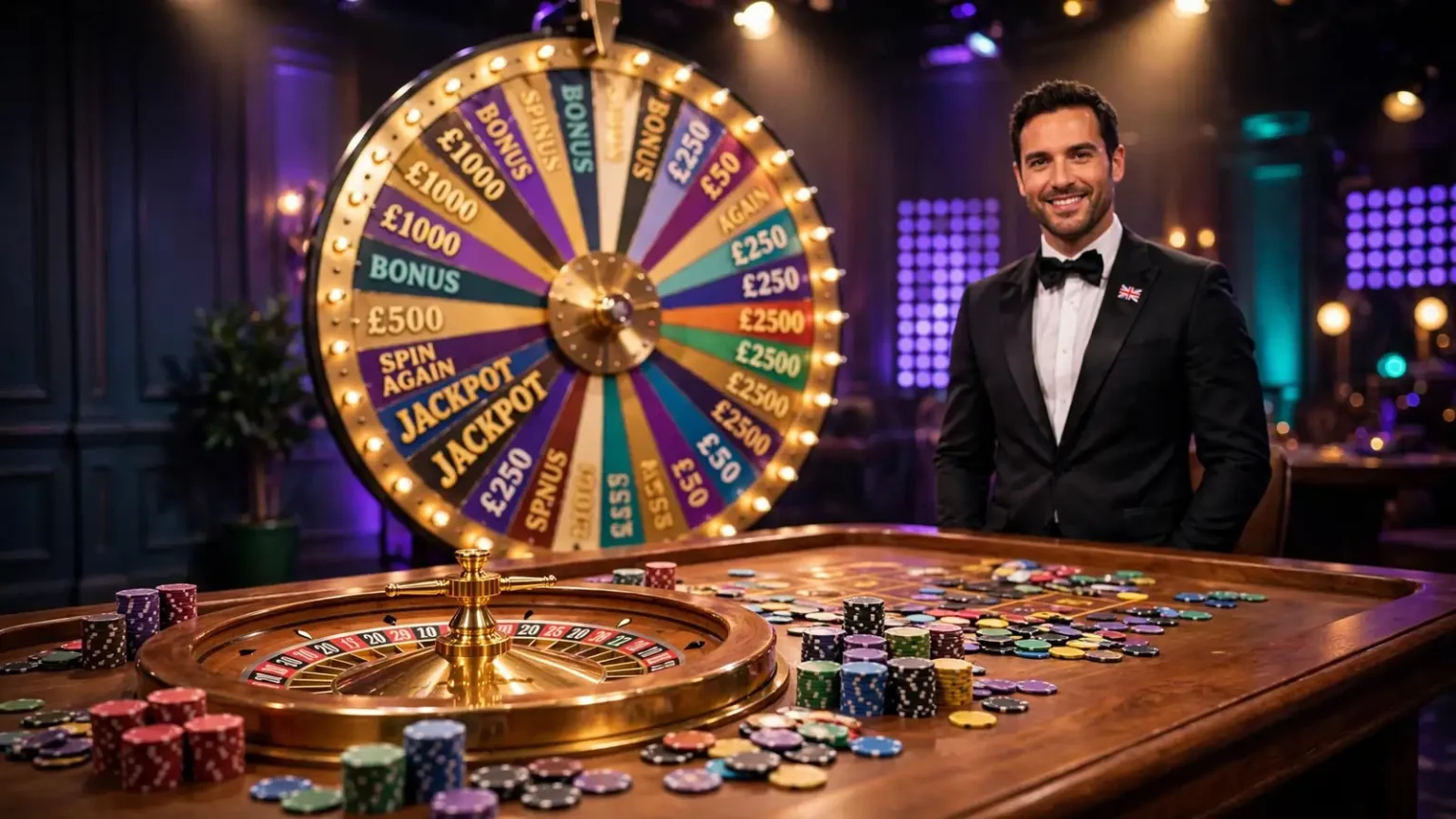
A live game show centres on a streamed presentation, with bets placed through the casino interface rather than a standard spinning game.
Live Casino Game Shows: The Format, Not a Slot
A live casino game show is a real-money casino format presented as a broadcast rather than as a standard spinning game. You see a live studio or presenter-led production on screen, while your bets are placed through the casino interface. The result is meant to feel closer to joining a televised show than opening a conventional reel game.
That difference matters because the word “game show” is often used loosely. It can make a regular casino game sound more theatrical than it is. A genuine live format has a presented, streamed element at its centre. It is not simply a slot with bright graphics, sound effects and a bonus round dressed up as entertainment.
I have made that mistake myself. A colourful lobby tile can suggest a whole television-style experience, but the label alone tells you very little. The useful question is not whether the game looks energetic. It is whether the live presentation is part of the actual way the game operates.
What “live” means here
In this context, “live” refers to the presence of a broadcast-style host, studio setting or real-time presentation connected to the game session. The screen may show a presenter, a set, a control area or other parts of a production. The exact appearance varies between products, but the basic idea is consistent: the casino game is delivered through a live-show environment instead of only through software-generated reels or symbols.
That does not turn it into a television programme that you watch for free. It remains a casino product. You normally enter through a casino lobby, choose a stake or participation option, and use the available controls while the presentation continues. The broadcast is there to frame the gambling activity and make the session feel more social and event-like.
No-Limit Online Casinos in the UK: What It Means
The word “live” also needs a little restraint. It does not automatically mean that every part of the outcome is created by a presenter in front of the camera. A host may explain what is happening, introduce stages of the round or keep the pace moving, while the actual result is produced by the game’s rules and systems. The presentation and the outcome are related, but they are not the same thing.
That is why I would not treat a host’s personality as evidence that a game is fairer, more generous or more predictable. A warm studio, quick jokes and polished graphics are production choices. They may make the session more enjoyable, but they do not change the fact that you are playing a casino game.
How it differs from a slot
A slot normally puts the reels, symbols and buttons at the centre of the screen. You choose your stake, start a game cycle and wait for the software to display the result. Even when the design includes a story or a bonus feature, the main experience is built around the game interface.
A live casino game show shifts the emphasis. The visual centre is often the presenter or studio, and the game unfolds as an event with a beginning, a sequence of actions and an ending. You are not just pressing a spin button and watching symbols land. You are following a presented round and making whatever selections the interface permits during the relevant stage.
Amatic Online Casinos in the UK: Games and Rules
That does not make the format automatically better. It makes it different.
Slots are often easy to understand at a glance because their core action is repetitive. A live game show may feel more involved because you have to follow the screen, read the available options and understand when participation is open or closed. The pace can also feel less private. Even though you are sitting alone with a phone or laptop, the host and studio create the impression that you are joining an ongoing session.
This is where the entertainment value can become distracting. I know the feeling of staying with a game because the presentation is lively, even after the gambling itself has stopped being interesting. The show keeps moving, so it becomes easy to confuse momentum with a reason to continue.
A broadcast wrapped around a casino game
The simplest way to understand the format is to separate three layers.
First, there is the presentation. This is the streamed or broadcast-style part: the host, studio, visuals, sound and general pacing. It gives the game its show-like identity.
Second, there is the player interface. This is where you see the available choices, place a stake, confirm an action or follow the status of the current round. It connects the broadcast to your account.
Third, there is the casino outcome. Whatever the game’s rules are, the result determines whether a particular wager wins or loses and what is credited according to those rules.
Those layers can appear to operate as one seamless experience, but they serve different purposes. The presentation attracts attention. The interface lets you participate. The outcome is what affects the balance of your account.
Format
Live casino game show
Core Element
Presenter-led broadcast
Interaction Level
High (choice-based)
Primary Focus
Entertainment and presentation
Keeping those roles separate is useful when a product is marketed as “immersive”, “interactive” or “next generation”. Such words describe the feel of the presentation, not the value of a wager. They should not be read as a promise of improved results.
Interaction does not mean control
Live show formats often suggest more involvement than traditional casino games. You may see buttons, choices, timing windows or other ways to take part. The precise options depend on the individual product, so I would not assume that every live game show works in the same way.
The important point is that interaction can affect what you do without giving you control over the underlying outcome. Selecting an option is not the same as deciding what result appears. A player can be active on the screen and still have no ability to guarantee, improve or reverse the result.
That distinction is easy to lose when the host speaks directly to the audience. The presentation may make the session feel personal, particularly when the screen shows other participants or creates the impression of a shared room. But a direct address is still part of the production. It is not an individual promise to you.
I find it safer to think of interaction as navigation through the game rather than influence over chance. You are choosing how to participate within the rules provided. You are not taking over the mechanism that produces the result.
Why people look for these games
The appeal is usually less about the basic act of gambling and more about the setting around it. Some players find ordinary slots repetitive. A presenter, a studio and a visible sequence of events can make the session feel less mechanical. Others like the sense of occasion: the game appears to be happening now, rather than waiting silently behind a button.
Amatic Online Casinos in the UK: Games and Checks
There is also a social suggestion to the format. You may see signs that other people are present, or the production may be designed to feel like a shared event. That can make online play seem less solitary, even though your decisions and your account remain your own.
For me, the attraction is easy to understand. A live format gives you something to watch between decisions. It has a rhythm. You can follow the presenter, see the round develop and feel that you are part of a continuing programme rather than looking at a static game screen.
The trap is that better entertainment can make a longer session feel harmless. It is still possible to spend more time and money than intended because the show provides a reason to stay. The format is designed to hold attention. That is not a criticism of one particular product; it is simply part of understanding why the category feels different from a plain slot.
A live game show is not a live dealer table
The terms can overlap in casual conversation, but they are not necessarily interchangeable.
A live dealer table generally presents a dealer conducting a recognisable casino table game through a streamed feed. A live casino game show uses the same broad broadcast idea but gives the production a more programme-like identity. The host, set and structure may be more prominent than the traditional table itself.
That does not mean every product fits neatly into one label. Casino websites may group several formats under a general live casino heading. One lobby can contain table games, presenter-led shows and other streamed experiences. The category name is therefore only a starting point.
If you are trying to understand a particular product, ignore the banner for a moment and look at what is actually on screen. Is there a presenter? Is the session structured as a show? Are you watching a broadcast while using a betting interface? Or is it a conventional software game with a dramatic theme?
The answer tells you more than the heading.
DO
- Check the operator’s UKGC licence
- Verify the legal business name
- Read the specific game rules
DON’T
- Assume a brand name is the operator
- Trust promotional labels blindly
- Confuse software providers with casinos
Why “best” is a slippery word
People often talk about the best live casino game shows as though there were an objective ranking. I do not think there is one. The best fit depends on what you want from the format: a presenter-led experience, a particular pace, a simple interface, a stronger sense of theatre or something that feels closer to a traditional casino session.
A product can be technically polished and still not suit you. Another can look less impressive but be easier to follow. One player may want constant presentation; another may find the host distracting and prefer a quiet table or slot.
The word “best” also says nothing about the gambling result. A show can be the best match for your taste without offering better odds. Entertainment, usability and potential returns are separate questions. Combining them into one glowing label is how advertising language starts doing too much work.
When I compare live formats, I would keep three judgements apart:
- The show experience: whether the presentation is clear, watchable and suited to your taste.
- The game experience: whether you understand what actions are available and when you can take them.
- The gambling decision: whether the wager fits the money and time you intended to use.
Only the first two describe the format itself. The third is personal and should not be smuggled in as a claim about how exciting the show feels.
Watching, joining and playing
There are three different ways people may describe their relationship with an online casino game show.
You can watch the presentation without treating it as entertainment in its own right. The screen is there to show what is happening, but watching does not make the activity television. The purpose remains connected to casino play.
You can join a session by opening the game and following the available stages. This describes entering the live environment, not necessarily placing a wager at every moment.
You can play by making a real-money selection through the casino interface. This is the point at which the show experience becomes a gambling transaction for you.
Those words are sometimes blurred in promotional copy. “Join the action” sounds lighter than “place a wager”, but the financial meaning has not disappeared. I prefer to translate the language back into plain terms before continuing. If money is being risked on an outcome, it is gambling, however polished the studio looks.
Amatic Slots at UK Online Casinos: What to Check
The role of pace and attention
A standard slot can also be fast, but its rhythm is usually controlled by repeated game cycles. A live show introduces a different pace. There may be pauses, announcements, visible stages or a host waiting for the next part of the session. That can make the experience feel more deliberate.
It can also create pressure. When a round appears to be moving towards a closing point, you may feel that you have to decide quickly or risk missing it. The sense of a limited moment is part of the drama. It is not proof that the decision is valuable.
This is one reason I would avoid treating a live show as a social obligation. You do not owe the presenter, the other viewers or the running session another wager. If you miss a round, the programme continuing without you is not a loss that needs correcting.
A show can be entertaining without requiring constant participation. That is a useful mental separation, especially on a mobile screen where the betting controls sit close to the video.
Mobile presentation and the shape of the screen
Live casino game shows are designed to be viewed through an online interface, so the experience depends on more than the studio feed. On a smaller screen, the host, game information and betting controls may compete for space. A layout that feels clear on a computer can feel crowded on a phone.
On smaller screens, the host, game information, and betting controls may compete for space, making the interface feel crowded.
That matters because the format asks you to watch and act at the same time. If you cannot easily see the relevant information or tell whether an action has registered, the show may be enjoyable to watch but awkward to play. Bigger production values do not solve a poor interface.
I would also separate technical smoothness from game quality. A clear stream and responsive controls make the experience easier to follow. They do not change the rules or improve the outcome. They simply remove a layer of frustration.
What this format is — and is not
A live casino game show is a presenter-led or broadcast-style casino experience delivered through an online gambling interface. Its identity comes from the combination of live presentation, structured play and real-money participation.
It is not simply a slot with a louder soundtrack. It is not automatically a live dealer table. It is not a television programme detached from gambling. And it is not better value merely because it feels more interactive.
The format can be appealing because it gives the session a face, a voice and a sense of occasion. I understand that appeal. I also know how quickly a good show can make an ordinary wager feel like part of an event.
So I would start with the plain description: you are watching a casino game presented like a show, and you are using an online interface to take part. Everything else — the atmosphere, the host, the graphics and the excitement — sits on top of that basic arrangement.
Choosing a UK Casino for Live Shows Means Checking Its Licence
A live show appearing in a casino lobby can look reassuring. There is a presenter, a polished interface, and a button inviting you to join. I used to read that presentation as a kind of approval stamp. It is not.
A game page tells you that the operator has placed something in its lobby. It does not, by itself, tell you that the operator is authorised to provide remote gambling to people in Great Britain. The important check belongs to the casino account you are about to use, not just to the game title, studio branding, software provider, or search result that led you there.
New UK Online Casino Sites: Licence and Bonus Checks
That distinction matters when you are looking through online casinos with live game shows. A platform may describe itself as a destination for live entertainment, place a show in a prominent category, or display several live tables beside it. None of those things replaces checking the operator’s UKGC licence.
The lobby is advertising. The licence is the legal point.
The operator is the party you are dealing with
When you open an account, deposit money, request a withdrawal, accept bonus terms, or contact customer support, you are dealing with the casino operator. The operator is responsible for the remote gambling service offered to you. A game provider may supply software or content, but its name in a lobby does not turn it into the casino holding your account.
That is why I would start with the operator’s identity rather than with the show itself. Find the legal business named in the casino’s terms, footer, or licence information. Then check whether that business appears as the holder of a current UKGC operating licence.
This is particularly important when several websites use similar wording for live entertainment. “Live casino”, “game shows”, and “studio games” can be used as categories or promotional labels. They are not licence types. Nor does a recognisable brand automatically tell you which company is accepting your deposit.
I have made the easy mistake before: I saw a familiar name, assumed the rest had already been checked, and moved straight to the game list. That saves a minute at the start and can create confusion later. Start with who operates the account. Everything else follows from that.
What the UKGC licence tells you
The UK Gambling Commission regulates gambling activity in the UK, including remote casino services. For consumers in Great Britain, its remit applies to remote gambling even when the equipment supporting the service is located somewhere else. The physical location of a server, studio, or other technical equipment is therefore not a substitute for the operator’s UKGC status.
Attention The physical location of a studio or server does not substitute for an operator’s UKGC authorisation.
The Commission is the sole regulator for commercial gambling in Great Britain. That makes the UKGC licence the relevant reference point when you are assessing a casino intended to serve British customers. A foreign company location, an international software brand, or a separate overseas authorisation does not provide the same answer.
There is also a difference between business licences and personal licences. The Commission grants operating authorisation to businesses, while individuals working in relevant operating roles can hold personal licences. When you assess a casino, the question you need answered is whether the business providing the remote gambling service has the appropriate operating authorisation.
That sounds dry. It is still more useful than a “best casino” badge.
A game listing is not proof of approval
Suppose you find a casino advertising live game shows. You click through and see a particular title listed in the lobby. What has that established?
Only that the casino is presenting the title there. It has not independently established that the casino is authorised to serve you in Great Britain. It has not established that the listing is current. It has not established which legal entity would handle your account. And it has not converted the game’s presence into a UKGC approval.
The same applies when a casino displays a provider logo, a studio name, or a “featured” label. Those details may help you understand what the lobby claims to offer, but they are not a replacement for checking the operator. A catalogue is not a regulator’s register.
I would also avoid treating a result on a comparison page as the final word. A page can describe a casino as one of the best live game shows casinos without showing which company is licensed. Promotional language ranks or recommends; it does not grant permission to operate.
Check the name, not just the logo
The name shown to players may be a trading brand rather than the legal business named on the licence. That is where a quick visual check can fail. A logo can look familiar while the account terms identify another company.
Wazdan Online Casinos UK: Amatic Slot Guide
Before depositing, look for the operator’s legal name in the site’s licence information and terms. Compare that name with the current entry in the Gambling Commission’s Public Register. The purpose is not to prove that the lobby is attractive or that a show is available. It is to confirm that the business offering the remote gambling service has the relevant UKGC operating licence.
If the information does not line up, I would stop rather than fill in the gaps myself. A missing company name, an unclear licence reference, or a brand that cannot be matched to the listed operator is not something a game category can fix.
A simple check is better than a confident assumption.
Great Britain is the relevant regulatory boundary
The UK is often discussed as one market, but the legal wording around remote gambling matters. The UK Gambling Commission regulates remote gambling offered to consumers in Great Britain. Its role covers commercial gambling activity there, including online casino services.
That is why a site saying it accepts customers internationally does not answer the question for a British player. Nor does the presence of equipment, staff, or a live production operation outside Great Britain answer it. The relevant issue is whether the operator serving consumers in Great Britain has the required UKGC operating licence.
I would be careful with vague statements such as “licensed in the UK” when the site does not identify the actual operator. Ask which company holds the authorisation and whether that company appears in the Commission’s current records. The wording may feel bureaucratic, but it removes the ambiguity that marketing copy tends to create.
Do not confuse software approval with casino approval
A supplier can have permission to provide gambling software without being the consumer-facing casino. Those are different roles. Even when a provider has a UK Gambling Commission software licence, that does not mean every website displaying its content is approved to accept British players.
The operator remains the party that offers the account and remote gambling service. Its UKGC operating licence is the check that matters for the casino you are considering. A provider’s licence, a studio’s reputation, or the technical quality of a live broadcast cannot stand in for it.
This is one of those distinctions that sounds obvious after someone points it out. In a busy lobby, though, the provider’s name may be much larger than the operator’s legal details. I now treat the prominent branding as information about the product, not as evidence about the account.
Betsoft Online Casinos UK: What Can Be Verified
What to do when a site says it is “regulated”
The word “regulated” on its own is too vague. A website may refer to regulation in another jurisdiction, use the word in promotional copy, or mention a company connected with the brand rather than the business taking your deposit.
Look for a clear UKGC reference tied to the operator. Then verify the legal entity through the Gambling Commission’s Public Register. If the site only offers a badge or a sentence with no identifiable business behind it, the check is incomplete.
This does not require you to decide whether a particular live show is entertaining, fair-looking, or worth your time. It is a prior question: is the casino offering the account authorised for the British market? Until that is clear, comparing show categories is putting the cart before the horse.
Be wary of lists of “best” casinos
A list of online casinos with live game shows can be useful as a starting point, but “best” is not a regulatory category. A recommendation may be based on lobby design, the number of advertised titles, a promotion, or the writer’s commercial relationship with the operator. None of those details confirms a UKGC operating licence.
I would use such a list only to identify names for checking. I would not take inclusion as proof that the site is permitted to serve Great Britain. The verification still belongs with the operator’s legal identity and the Commission’s current record.
The same applies to a search result that appears to answer the question immediately. A result can point you towards a casino, but the responsibility for checking the business behind it remains. The attractive shortcut is often the least reliable part.
The practical order of checks
When I assess a casino that claims to offer live shows, I keep the order plain:
- Identify the business operating the casino account.
- Find the UKGC information connected with that business.
- Match the legal name against the Gambling Commission’s Public Register.
- Confirm that the authorisation belongs to the operator, rather than merely to a software supplier or another company.
- Only then examine the casino’s own lobby to see what it currently presents.
That final point is important. A licence check does not prove that any particular show is available. Lobbies change, products can be removed, and a category label may not mean what you expected. The licence answers the market-authorisation question; the operator must answer the product-availability question.
I would contact the operator if the lobby and the terms do not agree. Ask which legal entity operates the account and whether the advertised live-show content is available to your account in Great Britain. Keep the question narrow. You are checking what is being offered, not asking advertising copy to explain the whole regulatory structure.
Offshore wording does not solve the UK check
A casino may mention an overseas licence or present itself as an international platform. That does not make it part of the UKGC system. Remote gambling operators selling into the British market must hold a Gambling Commission licence, regardless of where their key equipment or corporate operations are located.
Regulatory Priority
Always verify the legal operator via the UKGC register before playing.
So an offshore authorisation is not an alternative answer for a player looking for live game shows in the UK. It may explain how the site describes its wider business, but it does not establish the UKGC status required for the British market.
This is where I stop trusting phrases such as “fully licensed” unless the site identifies the licence and the operator behind it. Fully licensed where? By whom? For which company? If those basic questions are left hanging, the slogan has done more work than the evidence.
No slogan, just the register.
Keep the licence check separate from the show choice
It is tempting to combine every decision into one impression: a polished stream, a large lobby, a known brand, and a licence badge all blending into a feeling that the casino must be suitable. I prefer to separate the questions.
First, is the business offering remote gambling to Great Britain authorised by the UKGC? Second, what does that operator currently make available? Third, do the account terms and the product details match what you intend to use?
That separation prevents a game listing from carrying more weight than it deserves. It also avoids claiming that a casino offers a specific live show merely because a page, advert, or category suggests it. The operator has to confirm its current catalogue; the Commission’s register has to confirm the operator’s status.
For me, that is the sensible starting point for comparing live game shows casinos in the UK. Not a promise that every advertised title will be there, and not a ranking based on a glossy lobby. Just the identity of the business, checked against the regulator that covers commercial gambling in Great Britain.
Searching for the ‘Crazy’ or ‘Funky’ Show Style
Some people are not looking for a conventional online casino game. They want something that feels louder, more theatrical and less like pressing the same button on a standard slot. That is where phrases such as “crazy” and “funky” enter the picture. They describe a mood before they describe a product.
Amatic Slots at UK Casinos: How They Work
I understand the attraction. I have had enough quiet reels and identical-looking lobby tiles to see why a reader might want a live casino game show with more colour, music or presenter-led energy. But the wording can be slippery. A casino may use “crazy” as part of a title, a category label, a promotional description or simply a search tag. Those are not interchangeable.
The name alone does not tell you what you will actually get.
What the “crazy” style can mean
When you look for a crazy-style live casino show, you may be signalling that you want an entertaining presentation rather than a traditional table layout. The phrase can point towards a host-led experience, a studio setting, bright graphics, bonus-style moments or a format built around anticipation between results.
That is an interpretation of the label, not confirmation of a particular game. The same word can be used differently by different operators and software suppliers. One lobby may place a show under a themed category; another may use the term in an advert while offering something with a completely different structure.
I made this mistake myself with casino categories. I treated a dramatic label as if it were a technical description. It was not. “Crazy” was doing the selling; it was not explaining the rules.
Before you deposit, separate the atmosphere from the mechanics. Look for the actual game information supplied by the operator. You should be able to establish whether the product is live, whether a presenter is involved, how a round works, which outcomes are available and how a winning bet is settled. If those basics are hidden behind a large banner and vague wording, the label has not helped much.
Bright packaging, thin detail.
What people may mean by a “funky” show
“Funky” usually suggests a more playful or unusual presentation. You might be seeking a live show that feels less formal than a classic roulette or blackjack table, with a more distinctive studio identity or a stronger entertainment element.
Understanding Style Labels
Labels like “crazy” or “funky” describe the mood and atmosphere of a show rather than providing technical details about the game mechanics or rules.
Again, treat that as a description of the intended feel rather than proof of a defined game type. There is no universal rulebook for what makes a show “funky”. It could refer to the visual design, the presenter’s style, the pace of the broadcast or the way the operator groups its content. It does not, by itself, establish the betting options, return, volatility or availability.
That distinction matters because a familiar-sounding name can make you feel that you already know the product. I have clicked through on that assumption and found that the title told me far more about the marketing than the play. The useful information was elsewhere, normally in the rules, help panel or game details.
Do not fill the gaps with guesswork.
Do not assume the title proves availability
A live casino show can appear in an article, a video, a social post or an old results page without being available to you at the operator you are viewing. Lobby content changes, products can be removed, and search pages can continue to display descriptions after the underlying offer has moved.
For that reason, regard a named show style as a starting point, not a shortlist. Open the operator’s own lobby and check whether the relevant product is actually displayed there. Then open its information panel rather than relying on the thumbnail. If the page only repeats words such as “crazy”, “funky”, “exclusive” or “unmissable”, it still has not told you enough.
NetGame and Amatic Slots at UK Casinos: A Guide
Availability is not the same as suitability either. A show may match the atmosphere you wanted but still have rules, limits, timing or bet types that do not suit how you planned to play. The louder the presentation, the easier it is to forget that each round remains a wager with a financial result.
The confetti does not change that.
A sensible way to compare the styles
I would compare these labels in a plain order:
- Confirm the product identity. Make sure you are looking at a live casino game show and not a slot, an advert or a themed category page.
- Read the rules. Check how a round starts, how bets are placed and how outcomes are paid.
- Check the current lobby listing. A mention elsewhere is not evidence that the operator carries the product now.
- Look at the responsible-play controls. The operator should prompt you to set a financial limit before your first deposit, and a reduction to that limit must be applied immediately.
- Decide whether the presentation helps you. If music, graphics or a presenter make you chase losses or lose track of time, the style is working against you.
The point is not to reject energetic shows. I enjoy a bit of theatre when the information is clear. The point is to avoid treating a catchy adjective as a guarantee of a specific experience. “Crazy” and “funky” can help you describe the atmosphere you want, but only the operator’s current game information can tell you what is actually being offered.
What to Check Before You Join a Live Game Show
A live game show can look simple from the lobby: click the tile, choose a stake, and join the action. I have learned not to stop there. The lobby is an advert, not a complete explanation of what you are agreeing to.
Before joining a live game show casino table, I check the operator’s own information first. The useful details are often spread across the game page, help centre, terms and account section. If those pages do not line up, I treat that as a reason to pause rather than guess.
Confirm what the game actually is
Start with the basic classification. Is it a live dealer game, a random-number game, or a slot with a show-style presentation? Those categories are not interchangeable. The title and artwork may suggest one thing while the rules describe another.
Look for:
- the official game name;
- the game type;
- the rules or help link;
- the available stake options;
- the way wins are calculated;
- any bonus, feature or side-bet terms;
- the responsible-gambling information attached to the game.
Do not rely on a review page to fill in the gaps. A third-party description can be out of date, while the operator’s lobby may have changed since it was written. If the page does not clearly explain the product, I would not deposit just to discover how it works.
That has saved me from a few “fun” surprises.
Check the operator, not just the game tile
The presence of a live game show in a lobby does not, by itself, tell you enough about the account, payments or complaints process. Those are handled by the operator.
Before depositing, check the operator’s current UKGC licence details in the Gambling Commission Public Register. The licence should belong to the business taking your deposit and responsible for paying any valid winnings. A software or content provider is not the same thing as the consumer-facing casino.
This distinction matters because a provider can supply games without accepting British players’ deposits. The operator remains responsible for account verification, payment handling, bonus terms, customer support and the route for complaints.
I also check that the site clearly identifies the licensed business in its footer and terms. A familiar brand name is not enough if the legal entity is unclear.
Best Barcrest Online Casinos UK: What Can Be Verified
Read the table and account limits
The game page should show the permitted stake range and any limits that apply to the table. Check those details before joining, particularly if the game offers several betting choices or a separate side feature.
Do not assume that a limit shown in a general casino policy automatically explains every live product. The individual game rules should tell you what can be selected and how the final result is settled.
If the product is treated as an online slot, the statutory stake rules matter: the maximum per game cycle is £5 for customers aged 25 and over, and £2 for those aged 18 to 24. That does not mean every show-themed product falls into that category. Check the operator’s classification instead of applying a slot limit blindly.
Check the offer before accepting it
Promotional language can hide the part that affects your withdrawal. Before activating an offer, look for:
- the qualifying action;
- which games count;
- whether live games are excluded;
- the wagering requirement;
- the expiry condition;
- the maximum stake allowed while the bonus is active;
- what happens to winnings if the terms are broken.
For UK customers, bonus wagering requirements are capped at 10×. That cap does not turn an unclear promotion into a good one, and it does not mean every game contributes in the same way. A live game may contribute nothing, partly, or under a separate rule.
I never accept a bonus when the operator makes me hunt through several pages to find the answer. “Instant” is often just a label for money with conditions attached.
Verify payments and identity requirements
The operator must verify your age before allowing a deposit, and customer details must be checked before the first deposit. Have your name, address and date of birth recorded consistently on the account. A mismatch can delay payment checks later.
Use only the payment methods the operator confirms as available to you. Credit cards cannot fund remote gambling, including credit-card-funded e-wallet top-ups. If a payment page appears to offer a route that conflicts with this rule, stop and contact the operator rather than trying it.
Also check the withdrawal conditions before playing. The important question is not merely whether deposits are accepted, but how a valid withdrawal is requested, reviewed and paid.
Set controls before the first spin
UKGC-licensed operators must prompt you to set a financial limit before your first deposit. Set one that you can live with before entering a live game show, rather than choosing under the pressure of a broadcast or a running table.
A reduced limit must be applied immediately. GamStop is also mandatory for GB-licensed online operators, so use it if you need a break from remote gambling across participating operators.
Finally, decide your stop point before joining. A presenter, countdown or “last chance” message is designed to keep the session moving. It is not a reason to raise your limit or chase a result.
If the rules, classification, payment route or promotional conditions remain unclear, leave the table closed. There will be another lobby.
Which licensed UK casinos carry Amatic slots?
UKGC-licensed operators listed as carrying Amatic games include Betfred, Bet365, William Hill, 32Red, PokerStars, Ladbrokes, Paddy Power, Unibet, Virgin Games, Casumo, Sky Vegas, 888casino, Betway, Betvictor and Betfair. Check the casino’s current game or provider list before depositing, as availability can vary.
Are Amatic games licensed and legal to play in the UK?
Yes. Amatic holds a UK Gambling Commission remote gambling software licence, and its games are offered to British players through UKGC-licensed casino operators.
What are the wagering requirements at Amatic casino bonuses in the UK?
For bonus funds, UK rules cap wagering requirements at 10× the bonus amount. Some listed free-spin offers at 32Red, Betfred and bet365 have 0× wagering, so winnings are credited as cash without a playthrough requirement.
Can Amatic slots be played on a mobile phone in the UK?
Yes. Amatic games generally run as HTML5 games in a mobile browser, without requiring a download.
How does the UK’s 10× wagering cap affect Amatic casino bonuses?
Since 19 December 2025, wagering requirements on bonus funds at UK casinos cannot exceed 10× the bonus amount. The cap applies to the operator’s bonus terms, not to the Amatic game itself.