
A practical guide to reading the live-game screen, checking site details and keeping betting choices distinct from the game itself.
What a Live Dream Catcher Session Actually Puts on Screen
Dream Catcher is presented as a live casino game, but that label can make the whole thing sound clearer than it is. When I first looked at live-game listings, I treated the title as if it were already a full explanation. It is not. A name tells you which product you are looking at; it does not, by itself, tell you exactly what will appear on screen, how a round is presented, or which choices are available to the player.
That distinction matters if you are trying to understand a live Dream Catcher casino experience in the UK. A listing can place the words “live”, “casino” and “Dream Catcher” next to each other while leaving the useful details somewhere else in the interface. The product title is the starting point, not the rulebook.
Live does not simply mean “a video”
The word “live” suggests that something is happening in real time, often with a visible studio presentation rather than a purely computer-generated display. But I would not use that one word to fill in every blank. A live casino page may contain several layers at once: the game view, a presenter or table area, controls for joining a round, information panels, account features and promotional material.
Those layers are easy to confuse. A banner may describe the atmosphere. A short preview may show a moving wheel. A compact game tile may show only the name and a still image. None of those should automatically be treated as a complete description of the session itself.
When you open a live Dream Catcher game, separate what is actually part of the playing screen from what is simply surrounding page furniture. I find it useful to ask:
- What is the central game display?
- Which element shows the current stage of the round?
- Where are the available player controls?
- Is the information visible before joining, during the round, or only afterwards?
- Which buttons belong to the game, and which belong to the casino account?
That sounds basic. It saves confusion later.
Read the product label narrowly
“Dream Catcher casino” can describe the game itself, a page containing the game, or a wider casino category. “Dream Catcher live casino” may be used as a cleaner product label, but it still does not establish every feature a particular page might show. Even the wording “live Dream Catcher casino UK” can refer to a search result, a lobby tile or an actual game table.
I have made the mistake of treating all three as interchangeable. They are not. The safest reading is narrow: Dream Catcher is the named product, while the live-casino setting describes how that product is presented to you. Anything beyond that needs to be visible in the game interface or explained in the accompanying rules.
This is especially important when two pages use different images or layouts. A bright studio picture may be an illustration rather than a faithful map of every control. A cropped mobile view may hide panels that appear on a desktop screen. A casino lobby may also shorten the title, which makes it harder to tell whether you are looking at the actual game or a promotional card leading to it.
The screen should answer practical questions
Before concentrating on the excitement of the presentation, establish what the screen lets you see. You should be able to identify the round area, the player-choice area and the information that explains what is happening. If those parts are not obvious, do not assume that the missing detail is unimportant.
Pay attention to labels rather than relying on colour or animation. Moving graphics draw the eye, but they are not instructions. If a value, symbol or outcome appears on screen, look for the connected explanation: what it represents, when it becomes relevant and whether it is part of the current round or a record of earlier rounds.
Live Baccarat Online Casinos in the UK
The same applies to the host or presenter. Their presence can make the session feel more like a table game, but presentation is not the same thing as the rules. The host may guide the flow and announce events, while the actual player actions and outcomes are governed by the game system. I keep those roles separate. It is a small habit, but it stops atmosphere from being mistaken for information.
Check the round flow before doing anything else
A live session is easier to understand when you can follow its sequence. Look for signs of when a round opens, when player choices close, when the result is produced and when the next round becomes available. The exact labels may vary between interfaces, so do not assume that a familiar-looking button means the same thing everywhere.
The point is not to memorise the screen. It is to know when your action matters and when you are only watching. If the interface does not make that clear, slow down. A fast visual rhythm can make a player feel late, even when the important information is still available.
Casino Dice Games in the UK: What to Check
I also check whether the screen distinguishes the current round from previous results. A history panel can be useful for orientation, but it is still a record of what has happened, not a promise about what comes next. I have seen how quickly a sequence of past outcomes can start looking like a pattern. It is only a sequence. Keep it in its place.
Mobile and desktop may tell different stories
The live casino experience is not necessarily identical across devices. A desktop display may have room for a larger game window and more information around it, while a mobile layout may stack controls or hide secondary panels behind buttons. That can change how quickly you locate important information, even when the underlying product is the same.
For that reason, judge the screen you are actually using. Do not rely entirely on a promotional image captured elsewhere. Rotate the device if needed, enlarge the game view and check that labels remain readable before treating the presentation as understood.
Online Casino Games for Real Cash in the UK
A proper first look is less dramatic than the marketing version. You identify the product, distinguish the live display from the surrounding page, locate the round information and read the available instructions. Only then do you have a reasonable picture of what a Dream Catcher live casino session is putting in front of you.
The screen first. The excitement second.
Live Casino Games: Providers and the Familiar Table-Game Neighbours
Dream Catcher makes more sense when you place it beside the rest of the live-casino floor rather than treating it as a complete casino category on its own. A casino site may show a wheel-based title beside card tables, roulette rooms and branded game shows. The surrounding menu can make the whole section look like one product, but several different businesses and formats may sit behind it.
That is where providers come in.
What a provider does
A provider is the company responsible for supplying a game or the technology behind it. Depending on the title, that can involve the studio presentation, dealer interface, game software, streaming setup and the way results are displayed on screen. The casino is the place where you access the game; the provider may be the organisation that created and operates the underlying product.
Those roles are easy to blur. I have done it myself, assuming that a casino’s logo on a game meant the casino had produced it. Often, the casino is presenting a catalogue assembled from several providers. The name shown in the lobby may identify the game, the operator, the studio or a combination of those labels.
Evolution is one game provider associated with products in the live-casino space. Eyecon and NetEnt are also names you may encounter in the wider online-casino industry, although a provider name alone does not tell you how a particular title is presented at a particular casino. A listing can be useful, but it is not the same thing as a description of the whole live experience.
Blackjack
A card game built around decisions, such as whether to take another card or stand, with a dealer running the table.
Roulette
A game featuring a wheel, a ball, and a table layout, often with a live dealer or studio presentation.
Texas Hold’em
A familiar poker-style game that often appears in live-casino catalogues.
For Dream Catcher, the practical point is simple: separate the title from the shop window around it. “Live Dream Catcher” describes the game presentation a player is looking for. It does not automatically describe every other game in the casino lobby, the payment service, the customer-support setup or the operator behind the page.
Different questions. Different answers.
The table-game neighbours
Most live-casino menus place a wheel or game-show-style title near more recognisable table games. Blackjack is the obvious neighbour. It is a card game built around decisions, such as whether to take another card or stand, with a dealer running the table. That makes the experience feel different from watching a central game unfold and choosing a wager around it.
Roulette is another familiar option. The visual language is usually immediate: a wheel, a ball and a table layout. A live version adds a dealer or studio presentation, while the casino interface handles the selection and account display. It may appear next to Dream Catcher because both use a prominent visual focal point, but the resemblance ends there unless the individual game’s rules say otherwise.
Texas Hold’em also appears in live-casino catalogues. Grosvenor first introduced its live casino games in 2013, with a range that included Blackjack, Texas Hold’em and Roulette. That history shows how the live section can contain several established casino formats rather than one narrow style of play.
You may also see products such as Infinite Blackjack and Lightning Roulette. Their names tell you they are branded live-casino offerings, but the branding should not make you assume that every title works in the same way. A named variant may have its own interface, table arrangement and presentation. Read the game information attached to that title instead of carrying assumptions from a different table.
Online American Roulette in the UK: Rules and Licensing
Why the wider menu matters
Looking at the neighbours helps you understand what a casino means when it advertises a “live casino” area. The label can cover card games, roulette products, wheel-led shows and other studio formats. It is a broad shelf, not a single type of game.
That matters when you are trying to find Dream Catcher online. A large live lobby may place the title among many tables, while a smaller one may show only a few products. The number of nearby games does not prove that the Dream Catcher presentation is better, newer or more suitable for you. It only tells you how the operator has arranged its catalogue.
I also find it useful to distinguish between a provider’s title and the casino’s own navigation. A casino may group games by provider, by live studio, by popularity or by game family. Those labels are browsing aids. They are not a substitute for opening the individual information panel and checking what you are actually about to use.
The familiar table games provide a reference point, but they should not become a shortcut. Seeing Blackjack, Roulette or Texas Hold’em beside Dream Catcher does not establish that the wheel game follows the rules, pacing or wager structure of any of them. Nor does the presence of a well-known provider settle every question about the operator hosting the listing.
For a UK player, the live-casino section is therefore best read as a mixed environment. Dream Catcher may sit alongside established card and roulette products, with providers supplying titles and casinos presenting them through their own websites. Once you keep those layers separate, the menu becomes less mysterious. You can recognise the familiar neighbours without pretending they explain the game you came to see.
Essential Conclusions
- A casino’s live lobby is a mixed environment of different products and providers.
- Do not assume that seeing familiar table games explains the rules of Dream Catcher.
- Use the casino’s navigation as a browsing aid, not a replacement for game rules.
How to Compare Dream Catcher Casinos Without Chasing a “Best” Label
“Best” sounds useful until you try to pin it down. One casino may put Dream Catcher near the top of its live-games lobby, another may make the table easy to find but offer a less clear set of account controls. Neither detail, by itself, tells you which option suits you.
I have made the mistake of treating a polished page as a recommendation. The headline looked confident; the useful information was buried elsewhere. My better approach now is to compare the things you can actually inspect, one site at a time.
Start with availability, not adjectives
First, check whether the casino clearly lists Dream Catcher as a live product. A search result, banner or promotional tile is not enough. Open the game page and see whether the information remains consistent when you move from the advert to the lobby and then to the account area.
Pay attention to simple details:
- Is the game clearly labelled as live?
- Can you find it without following several unrelated promotions?
- Does the page identify the provider or product consistently?
- Are the available wagering choices and any applicable terms shown before you start?
This is not about judging the wheel itself. It is about confirming that you are looking at the same product the casino is presenting in its marketing.
Compare the information, not just the appearance
A dark interface, a studio-style presentation and a large “play now” button can make two casinos look very different while telling you very little. I now open the help, terms and account pages before I decide whether a listing deserves further attention.
Useful comparison points include:
- Game information — Can you understand what you are being offered without relying on a slogan?
- Account conditions — Are the rules for deposits, withdrawals, bonuses and account closure written in plain language?
- Limits — Does the site explain how you can set or change financial limits?
- Support — Is there a clear route to customer support and to the operator’s complaints process?
- Responsible-gambling tools — Are self-exclusion and other controls easy to locate, rather than hidden in a footer?
None of these makes a casino “the best” for everybody. They do help separate a readable, checkable offer from one that asks you to trust the sales copy.
Treat licence checking as a comparison step
For a UK player, the operator’s regulatory position is not decoration. Remote operators serving Great Britain must hold the relevant Gambling Commission licence, and the licence should be checked on the Commission’s public register before you deposit.
Do not stop at a badge on the casino page. Follow the operator details and compare the name, domain and licence information with the register. A mismatch is not something I brush aside because the site has a familiar-looking design.
A specialist review reported that a Gambling Commission register dated 26 September 2026 did not show a LuckyPays entry under that brand or its stated domain, including luckypays.io. That is a time-specific report, not a permanent verdict about every site or a substitute for checking the register yourself. Still, it shows why the operator’s identity matters more than a “trusted” label.
Put promotions at the bottom of the list
Bonuses are the loudest part of most casino comparisons, so I leave them until the end. If a site fails the basic checks, a promotion does not repair that problem. If it passes, read the conditions rather than mentally spending the advertised reward.
DO
- Inspect the help, terms, and account pages
- Check the rules for deposits and withdrawals
- Verify the availability of responsible-gambling tools
DON’T
- Rely solely on polished marketing or slogans
- Assume a large “play now” button implies a good offer
- Ignore the fine print of promotional bonuses
Look for the wording around eligibility, wagering, expiry, game restrictions, withdrawals and what happens if you cancel. Those conditions can matter more than the headline offer. I have previously read only the large text and discovered the important part after registering. Annoying, but avoidable.
The same applies to payment claims. Compare the actual payment information and restrictions shown in the cashier and terms, not phrases such as “instant” or “ hassle-free”. Marketing adjectives are cheap. Clear conditions are useful.
Build your own shortlist
Rather than naming a single best live Dream Catcher casino, make a short comparison table for the sites you are considering:
| Check | What to record |
|---|---|
| Game listing | Whether the live product is clearly available |
| Operator identity | Name and domain shown across the site |
| Licence | Register result checked before depositing |
| Terms | Whether key conditions are accessible and understandable |
| Controls | Limits, self-exclusion and support options |
| Complaints | How to raise a complaint and find further help |
The winner, if there is one, should be the site whose details you can verify and understand—not the one with the biggest claim on its homepage. I would rather spend a few minutes checking than call a casino “best” because its advert was better written.
And whichever option you consider, only gamble what you can afford to lose. That is the one comparison rule I do not soften.
Dream Catcher Casinos: What to Check on a Site Before You Sign Up
When I look at a site advertising live Dream Catcher, I do not begin with the welcome offer or the game lobby. I start by checking whether the business is authorised to serve customers in Great Britain. A polished page can borrow the language of a regulated operator, display familiar gambling terms and still leave you unclear about who is actually responsible for the account.
That check matters before registration, not after a deposit. A casino offering remote gambling to people in Great Britain must hold the appropriate licence from the UK Gambling Commission. The operator’s location does not change that requirement. Whether its equipment, offices or company registration sit in Britain or elsewhere, the relevant question is whether it is licensed to provide remote gambling to British consumers.
Online Casino Tournaments UK: Rules and Checks
Find the operator behind the site
The first practical step is to identify the legal business operating the site. The brand name shown in a banner may not be the same as the company named in the terms and conditions. Open the footer, licence page and account terms, then look for the operator’s full legal name and licence details.
I have made the mistake of treating a recognisable brand as sufficient proof. It is not. A brand can operate through a separate company, and the company is what should match the regulator’s record. If the site makes it difficult to discover who runs it, that is already a useful warning sign.
Do not stop at a badge or a sentence saying “UK licensed”. Follow the details to the public register maintained by the UK Gambling Commission. Search for the legal operator, rather than relying only on the casino’s trading name. Confirm that the record corresponds with the website you are considering and that the permission covers remote gambling for Great Britain.
Regulatory Check
Always verify the operator’s legal name and licence details against the UK Gambling Commission public register before depositing funds.
Check the licence, not the appearance
The Commission is the UK body responsible for commercial gambling regulation in Great Britain, and it also oversees online casino activity within the wider United Kingdom regulatory picture. For a remote casino, the important point is that the operator must have the relevant authorisation for the service it is offering.
A site can look professional without proving anything about its regulatory status. A live studio, a secure-looking login screen and a long list of payment logos do not replace a licence check. Nor does a statement that the company is “internationally regulated”. That phrase may refer to an authority that has no role in authorising gambling for Great Britain.
The register also helps you distinguish between different kinds of permission. The Commission grants operating licences to businesses, while people who perform certain regulated roles may hold personal licences. For your purpose, the casino site needs to identify the business operating the gambling service and its operating authorisation. A person’s licence is not a substitute for the operator’s licence.
Match the details carefully
Once you locate a possible register entry, compare the details line by line:
- the legal company name;
- the trading name used on the casino site;
- the web address or domain associated with the service;
- the type of remote gambling permission shown;
- the status of the licence.
A mismatch does not automatically explain itself. It might reflect a group structure or a domain used by another company, but you should not fill that gap with guesswork. Ask the operator for a clear explanation and check whether the register supports it. If the site only supplies a logo, an unclickable licence number or vague wording about regulation, pause before creating an account.
This is especially important when several live Dream Catcher casino sites use similar branding. You are not checking whether the game title appears somewhere in a lobby. You are checking the particular business and domain that would hold your personal details, accept your deposit and manage any withdrawal request.
Read the site’s own legal pages
After the register check, read the casino’s terms, privacy notice and complaints information. The wording may be dry, but it should identify the operator and explain the relationship between the brand and the licensed company. I pay attention to whether the documents look specific to the site or read like unfinished template text.
The account terms should not contradict the licence information. If one page names one business and another names a different operator, do not assume the difference is harmless. Save the relevant page or note the details before signing up, because promotional pages can change while legal information is easier to compare later.
Mines Casino Game UK: Demo, Practice and Real Play
A proper regulatory identity does not make every offer attractive, fair or suitable for you. It answers a narrower question: who is authorised to provide the gambling service, and can that authorisation be checked independently? That distinction keeps the licence check useful instead of turning it into a vague seal of approval.
Treat missing information as a stop sign
If you cannot establish the operator’s legal identity, locate a matching Commission entry or confirm that the site’s domain belongs with that entry, do not deposit while the uncertainty remains. I would not let a promised bonus, a busy live lobby or the presence of Dream Catcher rush that decision.
The UK Gambling Commission’s remit covers remote gambling supplied to Great Britain consumers, and the Commission is the sole regulator for commercial gambling there. That gives you a clear reference point: check the actual operator against the official record before treating a site as a legitimate place to open an account. A site that cannot survive that basic check has not earned your trust.
UK-licensed casinos are prohibited from accepting credit card payments for gambling purposes.
The Game and the Betting Choices: Keep the Two Separate
When I look at a live Dream Catcher casino game, I separate two things straight away: what the product is, and what a particular operator lets me do with it. They are related, but they are not interchangeable.
The name tells you which game you are looking at. It does not, by itself, tell you the complete round procedure, the available wager types, the minimum or maximum stake, or how a winning selection is settled. Those details belong in the game information and the operator’s rules. I have made the mistake of treating a bright game tile as if it were a full explanation. It is not.
That matters if your intention is to play Dream Catcher for real money. Before committing funds, look for the rules panel or help screen attached to the actual game, rather than relying on a short lobby description. Check what selections can be made, when wagers close, how the result is determined and whether the displayed options match the amount you intend to stake. If those points are hard to find, that is useful information in itself.
Crazy Time Live Casino in the UK: What to Check
Do not assume the category
The British stake rules for online slots are a separate issue. A specialist review states that the maximum stake for a slot game cycle is £5 for an adult aged 25 or over, and £2 for someone aged 18 to 24. That is a specific claim about online slots, not a description of every game carrying a casino label.
The same type of review says those slot limits do not apply to roulette or blackjack. That distinction is important, but it does not settle where Dream Catcher belongs. The game’s name, live presentation or wheel imagery is not enough to classify it for you. Nor should you borrow roulette or blackjack treatment simply because those games are commonly displayed in the same live-casino area.
So avoid a chain of assumptions:
- a casino lobby calls it a live game;
- the game includes a wheel or numbered choices;
- therefore it must follow roulette rules;
- or it must fall outside the slot-stake framework.
That reasoning skips the part that matters: the operator’s classification and the game’s stated rules.
What to check before wagering
Read the information shown beside the game, then compare it with the account and wager controls on the table. You should be able to identify the permitted choices, the value assigned to each wager and the point at which the round is locked. If the site gives only promotional language such as “immersive” or “exciting”, treat that as decoration, not an explanation.
I also would not assume that a game supports the same options at every casino. The underlying product may be recognisable, while the presentation, limits or available controls differ between operators. Confirm the details on the site where you plan to play, and only wager what you can afford to lose.
The Wheel Is the Hook; Don’t Guess at Its Mechanics
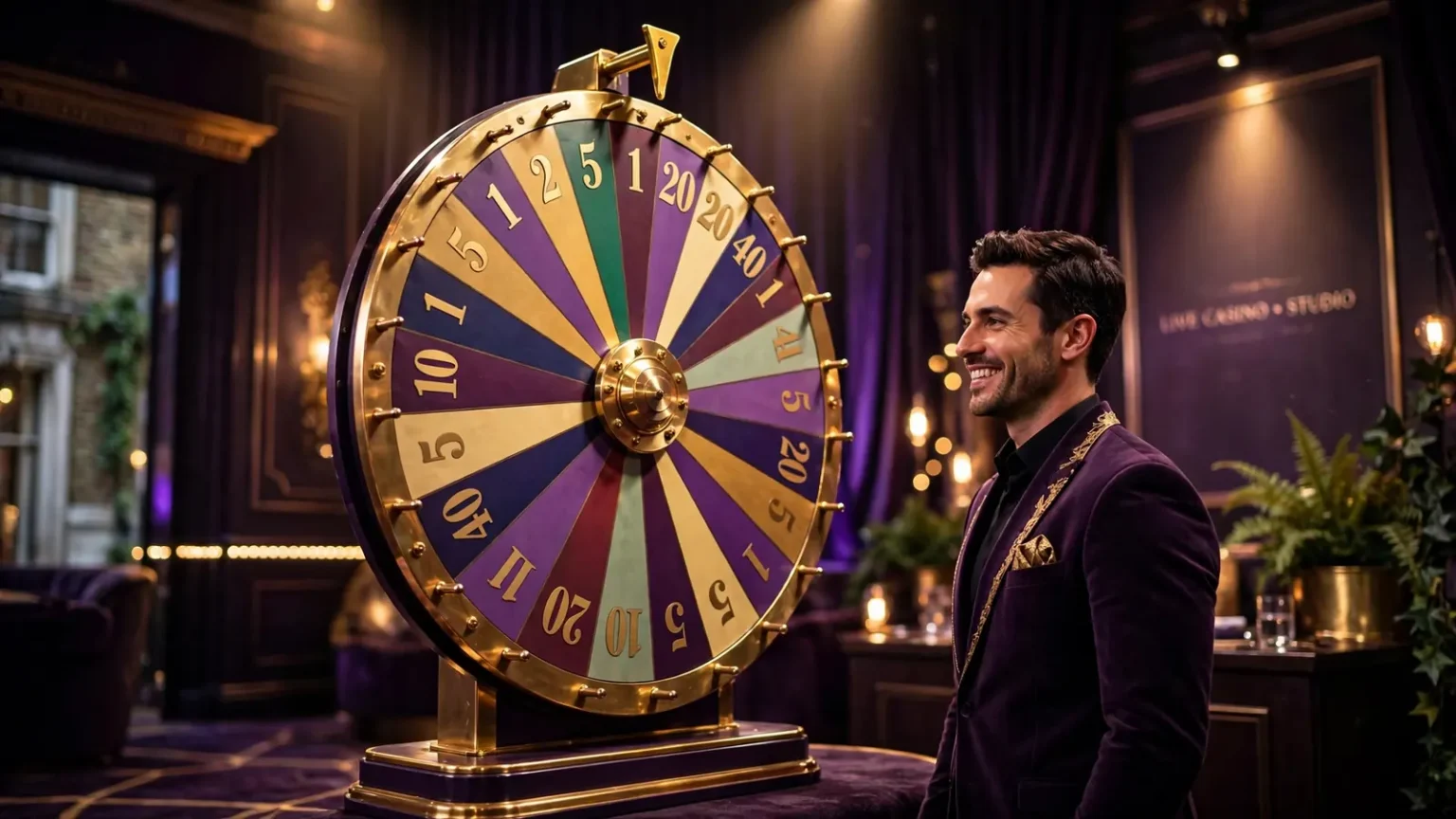
The wheel is usually the first thing that catches your eye when you open a Dream Catcher live casino page. It gives the game a clear focal point: a physical-looking object on screen, a presenter nearby, and a round built around a visible result. That makes the experience easy to recognise. It does not, by itself, tell you how the game works.
Attention Do not mistake the visual movement of the wheel or a presenter’s commentary for actual game mechanics or guaranteed outcomes.
I have made that mistake before. I saw a wheel, assumed I understood the important parts, and moved on without reading the information attached to it. A familiar format can create false confidence. The appearance is not the rulebook.
What the wheel can show you
A live wheel interface can help you understand the flow of the session. You may be able to see the wheel, the presenter, the current round status and the controls supplied by the casino. Those visual details matter because they show whether you are looking at a live presentation or a static game screen dressed up with casino language.
The display may also show labels or values around the wheel. Treat those as information to inspect, not as an invitation to fill in the gaps yourself. Check that they are clear, consistent and explained somewhere in the game information. If a label is difficult to read, do not rely on a guess made from the animation.
Most importantly, the wheel’s appearance does not establish its segment layout, the chance attached to any result, or the way a round is settled. Those are separate questions.
What not to infer from the animation
A result that has not appeared for a while is not automatically “due”. A large-looking section is not automatically more likely to land than a smaller-looking one. A dramatic spin is not evidence of a particular outcome, and a presenter’s commentary is not a substitute for the written rules.
That sounds obvious, but live presentation encourages quick decisions. I have found that the combination of movement, sound and a countdown can make an ordinary check feel like a delay. It is still worth pausing.
Before treating a Dream Catcher casino wheel as understandable, look for the game’s own explanation of:
- what the visible sections represent;
- how a result is determined;
- when wagering closes;
- how winning wagers are settled;
- whether the displayed wheel matches the rules shown on the page.
If those points are not easy to locate, the sensible conclusion is not that you have worked them out from the picture. It is that you need more information before wagering. The wheel is the hook. The details decide what you are actually looking at.
A Dream Catcher Demo: What You Can—and Can’t—Learn
A Dream Catcher demo is best treated as a practice screen, not a substitute for the live-money version. If you find one, the useful part is getting familiar with the interface: where the game controls sit, how the round is presented, how selections are made, and where the result appears. That removes some of the small awkwardness that can lead to rushed decisions later.
I have made that mistake myself. A new table can look obvious until you are trying to find the wager controls while the round is moving on. A demo gives you room to click around without turning every unfamiliar button into a money decision.
It can also help you decide whether the presentation suits you. Some players like a host-led live-casino atmosphere; others find the pace distracting. A no-money version lets you notice how the screen feels, whether the information is easy to follow, and whether you can keep track of your choices without pressure.
That is about as far as I would take it.
A demo does not tell you that real-money play will be available at a particular casino. It does not establish the casino’s terms, account conditions, limits, payment rules or responsible-gambling controls. Those are separate checks, and a polished practice screen should not be allowed to stand in for them.
Demo Limitations
A demo is only for learning the interface and cannot replace checking real-money terms or predicting future results.
Nor should demo results be read as evidence about future real-money results. A run of favourable or unfavourable outcomes on a practice interface gives you no sensible basis for predicting what happens later. I used to look for patterns in this sort of thing. It was just pattern-hunting.
Keep the two activities mentally separate: exploring the interface with no financial stake, and wagering real money through an account. If you move from one to the other, pause and read the conditions first. Make sure you understand what you are authorising before confirming anything, and only gamble what you can afford to lose. A demo can reduce unfamiliarity. It cannot make gambling predictable.
My Dream Catcher Casino Review Checklist
A useful Dream Catcher casino review should tell you what the listing actually offers, not repeat “exciting” or “trusted” until the page feels persuasive. I have been caught by that wording before. Now I check the practical details first.
European Roulette Casinos in the UK: What to Check
What I check on the page
- Game description: Does the casino clearly identify Dream Catcher and explain whether the listing is live play, a demo, or another presentation? Vague labels make it difficult to know what you are opening.
- Terms and conditions: Read the relevant rules before creating an account. Look for wagering requirements, excluded games, withdrawal conditions, identity checks and any restrictions attached to promotions. If the important parts are buried or written so broadly that they can mean anything, I treat that as a warning sign.
- Wagering and account limits: Check the minimum and maximum amounts the site permits for the game and whether your account can carry separate deposit, loss or session controls. A “flexible” limit is not useful if you cannot see it, change it or understand when it takes effect.
- Payment rules: The cashier should explain available methods, verification steps, processing conditions and fees in plain language. UK-licensed casinos cannot accept credit cards for gambling, and a wallet funded by a credit card cannot be used for that purpose either.
- Responsible-gambling tools: Look for time reminders, financial limits, reality checks, cooling-off options and self-exclusion. UK-licensed casinos must provide responsible-gambling tools, including self-exclusion. I also check whether the controls are available from the account area rather than hidden in help pages.
- Complaints route: A credible listing should explain how to complain internally and identify the approved Alternative Dispute Resolution service available if the complaint is not resolved.
Promotional language belongs at the bottom of my checklist. “Fast withdrawals” needs conditions; “safe” needs controls; “exclusive” needs a clearly stated offer. If the page supplies slogans but not usable terms, it has reviewed itself. I have not.
Before You Play Dream Catcher Live
Before I play Dream Catcher live, I do a short practical check rather than letting the table atmosphere make the decisions for me. First, I confirm that the casino holds a current UK Gambling Commission operating licence. I check the licence number against the Commission’s public register, not just a badge or a sentence in the footer. A site serving Great Britain needs the relevant remote gambling licence, wherever its key equipment or business is located.
The account setup matters too. The operator must verify your age before allowing you to deposit, and online gambling is for adults aged 18 and over. I also look for the financial-limit prompt before making a first deposit. Set a figure you can live with, then check where the account controls are so you can adjust your limits or restrict play without hunting through the site.
I would not use a credit card to fund gambling. UK-licensed casinos cannot accept credit-card payments, including some wallet routes that use credit-card money. That is a useful practical test of whether the cashier and its payment information have been explained properly.
Before starting a live session, find the responsible-gambling tools. A UK-licensed casino should provide account controls and self-exclusion, with GAMSTOP available as a wider self-exclusion option. If gambling stops feeling recreational, GamCare and Gamblers Anonymous offer support.
Most importantly, gamble only what you can afford to lose. I have ignored that sentence before and regretted it. Decide your limit while calm, not after a run of losing spins or an exciting round.
Are online casino games licensed and regulated?
Yes. The UK Gambling Commission regulates online gambling offered to consumers in Great Britain, and remote operators serving them must hold the relevant licence.
Is LuckyPays licensed by the UK Gambling Commission?
The Commission’s public register dated 26 September 2026 does not show a LuckyPays entry under its brand or stated domain, including luckypays.io. Remote operators serving Great Britain consumers are required to hold the relevant licence.
What are the online slot stake limits in Great Britain?
The maximum stake is £5 per game cycle for adults aged 25 and over, and £2 for adults aged 18 to 24. These limits do not apply to roulette or blackjack.