
Gamban and GAMSTOP address access in different ways, so a site’s status with one service does not establish whether it follows British gambling rules.
Why “Not on Gamban” Doesn’t Mean Outside UK Rules
“Not on Gamban” sounds more definite than it is. I understand why the phrase attracts attention: if you have installed Gamban or are trying to avoid gambling access, a casino described as a “non-Gamban casino” can appear to sit outside the usual barriers. But Gamban and GAMSTOP are not the same thing, and a label involving one of them does not decide whether an online casino follows British gambling rules.
Gamban is a separate self-exclusion service. GAMSTOP is the national online self-exclusion scheme for Great Britain. They address gambling access in different ways, so the absence of one service should not be treated as proof that a website is independent of every other safeguard. “Without Gamban” is not the same as “without self-exclusion”, and neither phrase tells you by itself whether a casino can legally serve customers in Britain.
That distinction matters when you see phrases such as “casinos not on Gamban”, “online casinos not on Gamban” or “UK casinos not on Gamban”. They are often used as if they describe a special class of operator. In reality, the wording may only say that Gamban does not identify or block the site in the way the reader expects. It does not establish that the casino is exempt from the Gambling Act 2005, from the Gambling Commission’s requirements, or from responsible-gambling duties.
For a real-money online casino serving customers in England, Scotland or Wales, the important regulatory question is whether the operator holds the relevant Gambling Commission licence. The operator’s location does not remove that requirement. An offshore business can be accessible from Britain, but an offshore licence is not a UK Gambling Commission licence. That is why a page presenting “best casinos not on Gamban UK” as a shortcut around British controls needs to be read very carefully.
Non-UKGC Licensed Casinos: What the Label Means
I have made the mistake of treating a technical description as a safety description. They are not interchangeable. A website may be reachable through a device, browser or payment route and still be unsuitable for someone who has chosen to stop gambling. It may also be subject to rules that have nothing to do with whether Gamban detects it. The words “no Gamban casinos” do not turn a gambling site into a legally unregulated space, nor do they turn it into a safe option for a person trying to keep away from gambling.
The same applies to the word “best”. A list of the “best casinos not on Gamban 2026” might be ranking availability, games, payments or some other commercial feature. None of those descriptions proves that the business will accept a customer who should be excluded, and none overrides a formal self-exclusion agreement. Searching for a site that appears to sit outside one blocking service can become an attempt to get around a decision you made for your own protection. Opening another account elsewhere is not a safe answer.
The British framework is broader than a label on a review page. Online gambling is legal in the UK only where the site is licensed and regulated locally. UK-licensed casinos must provide responsible-gambling tools, including self-exclusion, and gambling businesses must offer self-exclusion by law. That obligation is not cancelled because a marketing page calls the operator a non-Gamban casino. A business still has responsibilities towards customers who have asked to be excluded.
GAMSTOP is central to that regulated online picture. The Gambling Commission made participation compulsory for online operators on 31 March 2020. Since that change, every UKGC-licensed casino has been required to block customers who are self-excluded through the national scheme. That is a regulatory requirement, not a feature a casino can casually switch off to attract people looking for “casinos without Gamban”.
This does not mean every mention of Gamban tells you nothing. It may explain how a particular access-blocking service relates to a device or website. It simply cannot answer all the questions that matter: whether the operator is licensed for the British market, whether it provides the required safer-gambling tools, and whether your own self-exclusion status should prevent you from gambling there. One label cannot carry all that weight.
Regulatory Note
An offshore licence is not a UK Gambling Commission licence. A page presenting “best casinos not on Gamban UK” as a shortcut around British controls needs to be read very carefully.
Be especially wary when a page presents “best UK casinos not on Gamban” as a recommendation for someone already excluded. The word “UK” may describe the intended audience rather than confirm that the operator is licensed in Britain. The phrase “not on Gamban” may describe a technical relationship rather than a legal status. And “best” may be advertising dressed up as guidance.
If you are already trying to stop gambling, treat that wording as a warning to slow down, not as an invitation to test another site. Do not assume that a casino outside Gamban is outside British rules, and do not assume that being reachable means you are allowed, or advised, to use it. The separate national scheme and the operator’s own duties still matter. That is the line worth keeping clear.
What GAMSTOP Blocks—and How the Exclusion Starts
GAMSTOP is the UK’s multi-operator online self-exclusion scheme. Instead of asking one casino to close one account, you register with the scheme and the block applies across participating licensed online gambling websites and apps. That includes gambling operators holding a licence from the UK Gambling Commission.
That distinction matters when you are looking at a casino not on Gamban, or wondering whether a non-Gamban casino site would still be affected by your self-exclusion. GAMSTOP is not a browser filter or an app installed on your phone. It is a player-status check used across the licensed online gambling market. Once your registration is active, the relevant operators must prevent access to your current gambling accounts and stop you creating new ones with them.
Choosing a Casino: UK Options and Key Factors
I have seen this confused with blocking software before. Gamban works as a device-level tool, while GAMSTOP concerns your exclusion from online gambling operators. They are different services with different jobs. Searching for a non-Gamban casino does not alter how GAMSTOP operates, and it does not turn the scheme into a list of selected casinos. The important question is whether the gambling business is within the licensed online market covered by the scheme.
What a GAMSTOP registration covers
GAMSTOP is designed to cover multiple operators through one registration. Its purpose is to stop you moving from one licensed website or app to another after closing an account. The exclusion applies to current gambling accounts and prevents new accounts being created with the online gambling operators covered by the scheme.
The Gambling Commission made participation compulsory for online operators from 31 March 2020. That is why GAMSTOP is broader than an individual casino’s own safer-gambling tool. An operator can have its own account controls, but GAMSTOP provides a multi-operator route rather than requiring you to contact every licensed website separately.
The registration is free. You do not pay a casino, an app provider or the scheme itself to start the exclusion. Once it takes effect, the block is intended to apply for the fixed period you selected. It is not a casual account pause that can be switched off whenever you feel like playing again.
GAMSTOP Registration Periods
The available periods for exclusion are fixed options: six months, one year or five years.
The available periods are fixed options: six months, one year or five years. Those choices are long enough to create distance from gambling rather than acting as a short interruption. The exclusion remains in place for the period selected. If you are looking at online slots or a casino outside a Gamban block, that does not change the period attached to your GAMSTOP registration.
Starting the exclusion
Registration involves giving information that allows your identity to be checked. This is necessary because the scheme needs to match you with gambling accounts and prevent a new account being created under your details. It is not enough to rely on a screen name or an individual casino username.
The practical sequence is straightforward:
- You register with GAMSTOP and choose one of its fixed exclusion periods.
- The scheme verifies your identity.
- Once the registration is active, covered online gambling operators must block access to your existing gambling accounts and prevent new ones being created.
- The exclusion stays in force for the selected period.
The identity check is an important part of the process, not an optional extra. Without confirming who you are, the scheme could not reliably connect the exclusion with accounts held at different operators. That is also why trying a different spelling, email address or account route is not the point of the system. GAMSTOP is intended to operate across operators, not just against one login.
For me, the useful way to understand it is as a single decision with a wide reach. You are not asking a particular non-Gamban casino to be considerate. You are registering for a formal block across the licensed online operators covered by GAMSTOP.
What happens if you later request removal
GAMSTOP does not remove an exclusion immediately when you ask. First, you must contact the scheme directly and complete identity verification. Only after that verification has been completed does the 24-hour cooling-off period begin.
Your exclusion remains active throughout those 24 hours. Every removal request is subject to the same cooling-off period, and there is no expedited option. That pause is part of the process rather than a technical delay that can be skipped by contacting an operator directly.
The timing also means that asking a casino to reopen an account cannot override GAMSTOP. The operator cannot simply decide to ignore an active scheme registration. The request has to go through GAMSTOP, followed by the required cooling-off period.
I would treat that pause seriously. If the original registration was made because gambling had become difficult to control, a quick route back to casino accounts would defeat the purpose. The scheme’s operation is built around keeping the exclusion active while removal is being considered.
Non-UK Licence Casinos: What the Licence Means
So, when people talk about a no-Gamban casino or non-Gamban slots, they may be mixing together separate tools. GAMSTOP is the multi-operator exclusion route for licensed online gambling. It uses identity verification, applies across covered operators, and lasts for the fixed period selected at registration. That is the mechanism to understand before treating any casino label as relevant.
“Best” Is No Comfort If You’re Trying to Self-Exclude
I understand why someone searches for “the best” casinos that are not linked to Gamban. I made that sort of mistake myself: I treated the label as a technical detail, as though changing the site changed the agreement I had already made with myself. It does not. A recommendation can describe a website, but it cannot cancel a self-exclusion.
Self-exclusion is a formal agreement not to gamble. It is not a bonus restriction, a temporary account setting, or a request for an operator to make betting slightly less convenient. When you enter that agreement, you are taking on the responsibility of sticking to it. The business also has responsibilities, but those responsibilities are not there to help you find a loophole.
That matters when a page presents “non-Gamban casinos” as an easy alternative. The wording may sound like a neutral comparison, but the practical message can become: try somewhere else. I would not treat that as a safe recommendation for a person who has chosen self-exclusion. A site being described as “Gamban-free” says nothing, by itself, about whether opening an account fits with the exclusion you accepted.
DO
- Keep the exclusion active to maintain your decision.
- Treat the term “best” as a marketing label rather than a safety guarantee.
DON’T
- Assume a casino is unregulated just because it is not on Gamban.
- Use a different registration to find a loophole around self-exclusion.
What the agreement means in practice
Once a self-exclusion agreement has been made, the gambling business must take reasonable steps to prevent the excluded customer from gambling. That is an active obligation, not a suggestion to place in the site’s safer-gambling footer and forget about. The purpose is to stop the account being used for gambling during the exclusion.
The business must also close the player’s account, return any funds held in it, and remove the player’s details from its marketing databases. Those actions are part of the arrangement. They are not optional perks offered by a particularly thoughtful operator.
I used to look at account access as proof that an exclusion had somehow failed. That was the wrong way round. If an excluded customer can still sign in, deposit, or gamble, the issue is whether the business took the reasonable steps required of it—not whether the customer has discovered a promising new route. Either way, continuing to look for another place to play keeps the original problem alive.
There is no “best” ranking that changes those basics. A polished website, a broad game menu, or a review calling a casino “trusted” does not override a self-exclusion agreement. Advertising language is often built to make a decision feel like shopping. In this situation, it is not ordinary shopping.
Non-GamStop European Casinos: What the Label Means
Why switching sites is a poor workaround
A casino recommendation cannot tell you that gambling elsewhere is compatible with your agreement. The agreement is personal: you agreed not to gamble, and you remain responsible for following it. Passing through a different registration page does not make that responsibility disappear.
It is also risky to assume that a business will simply allow an excluded customer to continue because the customer uses different details or approaches a different brand. Gambling businesses must take reasonable steps to prevent self-excluded customers from gambling. Trying to work around the arrangement puts the focus in the wrong place and may conflict with the terms attached to the exclusion.
The same applies to pages that sort sites into “best” and “not affected” categories. That framing can make a formal safeguard look like a technical obstacle. I have seen how quickly that thought turns into another deposit, followed by the familiar attempt to explain it away. Not a solution.
If you have made a self-exclusion agreement, the sensible reading of a casino recommendation is therefore limited. It may tell you what a page claims about a business, but it cannot establish that you should register there. It cannot release you from the agreement. It cannot promise that gambling at another operator will be treated as acceptable.
Account Closure
After self-exclusion, the gambling business must close the account, return funds, and remove the player’s information from marketing databases.
The account should not remain a gambling option
The account consequences are important. After self-exclusion, the gambling business must close the account, return funds, and remove the player’s information from its marketing databases. That means the excluded account should not remain available as a normal place to deposit and play.
I would not read the return of account funds as permission to start again somewhere else. It is part of closing the excluded relationship, not a bankroll for finding a replacement. Likewise, removal from marketing databases is not an invitation to wait for a new offer from another brand. The point is to end the gambling relationship and reduce further prompts to gamble.
So when a page recommends the “best” non-Gamban options, I keep the phrase in quotation marks. “Best” may mean attractive to a customer who wants to play; it does not mean suitable for someone who has self-excluded. For that reader, the important question is not which casino looks better. It is whether using another casino would break the formal agreement they chose to make.
That is a much less exciting answer. It is also the honest one.
Online Slots Without Gamban: The UK Rules Still Apply
The phrase “online slots not on Gamban” can make the game itself sound like the important difference. It is not. Gamban is a blocking tool, while the slot still operates within the rules that apply to online gambling in Britain. Removing one layer of software does not remove those rules from the spin.
Non-UK registered casinos: licences and risks
I have made the mistake of treating a different gambling setup as a different set of consequences. The screen may look unfamiliar, but the basic controls still matter. If you are playing online slots in Britain, autoplay is not allowed. You must start each spin yourself.
That is not just a setting hidden in an account menu. A slot cannot run through spins automatically while you watch. Any feature designed to keep the reels turning without a fresh action from you is not permitted for online slots in Britain. The practical result is simple: no hands-off sessions and no letting the game continue unattended.
Each spin must also last at least 2.5 seconds. The rule concerns the game cycle, not how quickly you can tap or click. A rapid button press does not turn the slot into a faster product. The reels and the result still have to follow the required timing.
That can feel minor until you notice how quickly repeated play fills an evening. A short delay between spins is not a substitute for stepping away, but it does mean the game cannot be designed around instant, uninterrupted results. I would not mistake that rule for a safety guarantee. It is a requirement for the product, not a promise that the session will stay under control.
What the rules do not mean
“Best online slots not on Gamban” is still a phrase that can pull attention towards finding a particular game or a quicker route to play. The UK slot rules do not turn a game into a suitable choice for someone who is trying to self-exclude. They also do not make a slot acceptable simply because Gamban does not block it.
Attention Removing a blocking software like Gamban does not remove the UK regulatory rules from the game.
The same applies to pages describing the “best” online slots in 2026. A current-sounding label says nothing about whether playing is consistent with a self-exclusion decision. The relevant question is not whether the reels are available, familiar or fast. It is whether you have agreed not to gamble and need to keep that agreement intact.
For a single gambling website or app, the operator should provide instructions through its Responsible Gambling or Safer Gambling area. If you cannot find them, customer services can explain how to self-exclude from that business. That is a route to closing access, not a way to configure a slot around an exclusion.
I know the temptation to separate the game from the account behind it. The rules do not make that separation real. Autoplay remains banned, every spin must meet the 2.5-second minimum, and neither point should be read as encouragement to keep looking for another place to play. Product rules are still rules. Not an invitation.
Casino Sites and Slots: Don’t Use Another Account to Get Around an Exclusion
I understand why someone might look for casino sites or slots that are not covered by Gamban. I have made the same sort of mistake myself: treating a different website as if it were a clean escape route, rather than asking why I wanted to get around a block in the first place.
That distinction matters. Gamban is a blocking tool installed on a device. Self-exclusion is an agreement with a gambling business or a multi-operator scheme. Finding a site that is not blocked by Gamban does not cancel that agreement. It only means the technical block may not stop access there.
If you have excluded yourself from online gambling, opening an account elsewhere is not a safe workaround. A Non-GamStop casino could still be outside the terms of your self-exclusion, and playing there could breach those terms. The wording “not on Gamban” says nothing about whether using the site is consistent with the commitment you made to stop gambling.
Anjouan Casino Licence in the UK: What It Means
That applies whether you are looking for a casino account, a particular type of slot, or somewhere to play online slots in Britain. Changing the label from “casino” to “slots” does not change the underlying issue. You are still trying to gamble during a period when you decided, formally, not to do so.
I have also learned that a new account can create a false sense of control. You may tell yourself it is separate, temporary or only for one session. Then the practical problem becomes larger: another login to remember, another payment route, another operator to contact, and another chance of losing money while an exclusion is active. It is a workaround, not a solution.
Gambling businesses must provide self-exclusion by law. If you want to stop across online gambling operators, GAMSTOP ONLINE allows one request to cover that wider online exclusion. If you have already made that request, moving to another account elsewhere defeats the purpose of it. Keep the exclusion in place rather than looking for a site that does not appear in the block.
There is also a legal difference between sites. Online gambling is legal in the UK only where the operator holds the required UK Gambling Commission licence. An offshore casino may be accessible from Britain, but it sits outside the UKGC regulatory system. That does not make it a suitable place to continue gambling during self-exclusion, and it does not turn a blocked route into a safe one.
I would not rely on a site’s advertising language either. “Gamban-free” describes a technical relationship with a blocking service, not permission to ignore an exclusion. “Alternative casino” can sound harmless until you remember that the account is being opened for the exact activity you agreed to avoid.
If money has already been spent, the regulator cannot provide a refund for gambling losses. Chasing a different site will not repair that position. The more useful step is to stop creating new accounts and keep the exclusion active. If you are unsure what your existing agreement covers, contact the relevant self-exclusion service or gambling business before attempting to play.
Online casino Malta MGA licence: UK rules
A Casino Without Gamban Isn’t the Same as a Casino Without Self-Exclusion
When I first saw “casino without Gamban”, I treated it as if the label answered the important question. It did not. Gamban is one blocking tool; self-exclusion is an arrangement you make with a gambling business. A site can be outside Gamban’s blocking software and still have to provide its own self-exclusion process.
That distinction matters if you want to stop gambling with one particular online casino or app. You do not need to make the request through a multi-operator scheme to exclude yourself from that single business. Gambling businesses must offer self-exclusion, and UK-licensed casinos must provide responsible-gambling tools that include it.
Where to start
Look for the operator’s Responsible Gambling or Safer Gambling page. The self-exclusion instructions should explain how to submit the request. Follow that process rather than relying on a general account closure or simply deleting the app. Those actions may not amount to a formal self-exclusion.
If the instructions are hard to find, contact the casino’s customer-services team and clearly say that you want to self-exclude. Keep the wording unambiguous. You are asking the business to stop you gambling with it, not asking for help with a login or requesting a temporary account pause.
I have made the mistake of assuming that an account being closed meant the problem was dealt with. It is better to ask the operator to confirm that the self-exclusion has been recorded and to keep that confirmation. Small detail, but useful.
A single-business exclusion only concerns that gambling business. It should not be read as protection across other online casinos. If you may be tempted elsewhere, excluding yourself from one account does not cover those places. And if you have already decided to self-exclude, opening another account is not a sensible workaround.
“Gamban-free” describes a blocking arrangement, not the absence of safer-gambling controls. Check the operator’s own instructions. Then follow them properly.
Gamban-Free Sites and the Places You May Be Tempted to Gamble
A label such as “Gamban-free” tells me very little about whether a casino belongs on my list. It is not a recommendation, and it does not change the basic decision: which places do I need to block myself from using?
Exclusion Scope
Self-exclusion applies to all venues you have chosen to include, including online casinos, betting websites, apps, arcades, and betting shops.
That list may include online casino sites, betting websites, apps, arcades, betting shops or casinos you visit in person. I used to think about the one account I was currently using and forget the others sitting in the background. That is exactly how a self-exclusion plan ends up with a gap in it.
Self-exclusion is a request to a gambling business to stop you betting with it for a chosen period. It is not a badge attached to a particular type of website. If you exclude yourself from a venue or site, that business should refuse you service there during the agreed period. So the useful question is not whether a site is advertised as outside Gamban. It is whether every place that might tempt you has been included in your decision.
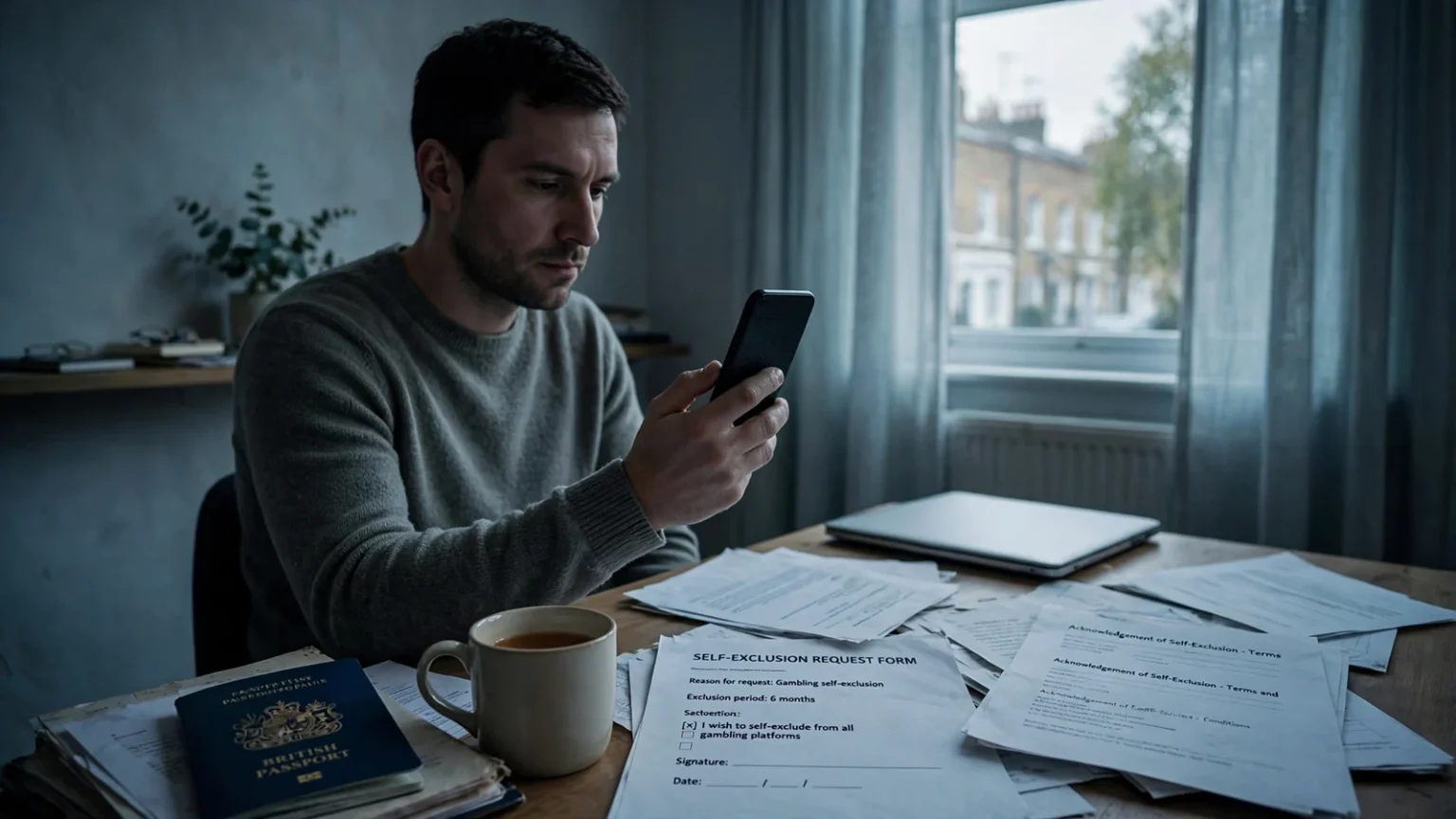
The process starts with identifying those venues or online sites and registering with each relevant arrangement. You provide personal information so your identity can be confirmed, choose how long the exclusion should last, and wait for confirmation that it has been recorded. The available period described for self-exclusion is generally between six months and five years.
Before registering, I would write down every account and venue that comes to mind, including places I have not used recently. An online casino I barely remember can still be part of the problem. Leaving it out because it is not visible today is not the same as removing the temptation.
Once the requests are made, keep the confirmations and check that the details match you. A “Gamban-free” description should never be treated as permission to look for somewhere else to gamble. If you are trying to stop, cover the whole route rather than searching for the uncovered corner. That is the safer objective.
No Gamban Slots Doesn’t Mean No Limits
A slots site not covered by Gamban is not automatically a place where normal account safeguards disappear. The label tells you only about Gamban’s blocking software. It does not tell you that the site is suitable for someone who has chosen to stop gambling, and it should never be treated as permission to ignore an exclusion.
For online slots in Britain, operators must prompt a new customer to set a financial limit before the first deposit is made. That prompt matters because it puts a boundary in place before money reaches the account, rather than relying on you to slow down after a losing run. I have ignored sensible limits before, thinking I would set one later. “Later” is a poor control.
The account should also include accessible limit controls. You need to be able to find the relevant settings without hunting through obscure menus, and the controls should apply at account level rather than being hidden inside one particular slot. These tools are there to help manage deposits or spending. They are not evidence that the operator will accept a customer who is excluded elsewhere, nor do they cancel a self-exclusion agreement.
Payment rules provide another safeguard. Remote gambling operators cannot accept credit-card payments for gambling. That restriction also covers credit-card funding routed through a money service business. A digital wallet does not change the position: an operator cannot accept wallet payments where the wallet allows credit-card funds to be used for gambling.
So, if you are checking a casino offering slots without Gamban, look at the practical controls rather than the marketing label. Is the financial-limit prompt shown before the first deposit? Can you reach account-level limits clearly? Is the payment method funded without a credit card?
Can I use credit cards for gambling?
Remote gambling operators cannot accept credit-card payments for gambling.
What are the financial limits?
Operators must prompt new customers to set a financial limit before the first deposit is made.
Those checks are about how an account handles money. They are not a workaround for self-exclusion. If you have excluded yourself, do not open or use an account on the assumption that these limits make gambling safe for you. Different issue.
What Happens When You Ask to Leave GAMSTOP
Leaving GAMSTOP is not something an online casino can arrange for you. You have to contact GAMSTOP directly and submit the removal request yourself. That separation matters if you are looking at casinos outside Gamban: a different gambling website cannot cancel your GAMSTOP exclusion or authorise access while it remains active.
The process includes a 24-hour cooling-off period after your identity has been verified. Every removal request follows that same wait; there is no expedited option. During those 24 hours, your self-exclusion stays in force. You are not temporarily “unblocked” while the request is being considered.
That pause gives you a chance to change your mind. If you decide that gambling access is not what you want, contact GAMSTOP during the cooling-off period and ask to keep the exclusion in place. The request can then be cancelled. I would treat that option as useful protection rather than an inconvenience. A rushed decision is still a decision.
Even after GAMSTOP completes the removal, operators may need another 24 to 48 hours to update a player’s status. Until that update has reached the relevant accounts, access may not change. Trying another route in the meantime is not a safe workaround, and an offshore or non-GamStop casino does not alter the status of your UK self-exclusion.
There is also a practical warning in the enforcement record. A regulatory enforcement notice recorded a £60,000 penalty on 26 June 2025 for breaches involving self-exclusion and consent for direct electronic marketing. The point is not that every operator will handle the process identically; it is that self-exclusion and marketing permissions carry real compliance obligations.
If you still want to stay excluded, say so directly to GAMSTOP before the cooling-off period ends. No shortcut.
Land-Based Casinos Are a Different Self-Exclusion Route
Gamban is not the route for excluding yourself from a physical casino. If you are standing at a land-based venue and want to stop yourself returning, speak to the manager or a member of staff. The customer service desk is the obvious place to start, although any staff member should be able to direct you.
I would take identification photos with me and keep a copy of the completed self-exclusion form. That sounds like admin when you are already uncomfortable, but having a record matters. It confirms what you asked for and gives you something to refer back to if the arrangement is unclear later.
This applies to more than casinos. The same direct approach can be used at an arcade or betting shop: go to the venue, tell the manager or staff member that you want to self-exclude, and follow its process. Gambling businesses must offer self-exclusion, so you are not asking for a favour or trying to negotiate a special arrangement.
If your aim is to stay away from every land-based casino in the UK, use SENSE rather than relying on a request made at one venue. SENSE is the route for a wider exclusion covering land-based UK casinos. That is a different arrangement from excluding yourself at a single casino, where the request is handled by that business.
So, when someone talks about casinos not affected by Gamban, a physical casino is not a sensible loophole to investigate. The relevant question is where you may be tempted to gamble and whether you have excluded yourself there. If that includes several venues, deal with the wider route instead of collecting separate promises from yourself one visit at a time.
Keep the paperwork. Make the request plainly. Then do not test it by going back.
How does self-exclusion work?
You register with GAMSTOP to exclude yourself from licensed online gambling operators across the UK, or contact an individual gambling business to exclude yourself there. The business must close your account, return any funds and remove your details from its marketing lists.
How do I return from self-exclusion?
You must contact GAMSTOP directly to request removal. A 24-hour waiting period applies to every request, and it may take operators a further 24 to 48 hours to update your status.
How does GAMSTOP benefit me?
GAMSTOP blocks you from accessing existing accounts or opening new ones with UK online gambling operators, free of charge. You can use one registration to exclude yourself across participating licensed websites and apps.
How long does it take for GAMSTOP to become active after sign-up?
After your identity is verified, GAMSTOP starts a 24-hour cooling-off period, and your exclusion remains active during that time.