
French roulette’s zero rules can reduce the house edge on even-money bets, while table format and stakes shape the playing experience.
Why French Roulette Gives You a Better Deal on Even-Money Bets
I used to look at roulette tables as if the colour of the felt told me everything. Red, black, odd, even — simple bets, simple payouts, surely a fairly simple game. The awkward part is the zero. It is the small green pocket that turns an apparently even contest into a losing one for the player over time.
French roulette deals with that zero more generously than the standard alternatives. Its advantage comes from two rules: La Partage and En Prison. They do not make a winning system out of roulette, and they do not change the fact that every spin is decided by chance. They do, however, reduce the casino’s mathematical advantage, especially when you place an even-money bet.
Why the zero matters
An even-money bet covers options such as red or black, odd or even, and high or low. If your chosen side wins, the normal return is one-to-one: a stake wins an equal amount. If it loses, the stake is gone.
The zero sits outside those pairs. It is neither red nor black, neither odd nor even, and neither high nor low. When the ball lands there, an even-money bet normally loses even though the number has not matched either side in the way a player might expect.
That single pocket is enough to give the house an edge. French roulette’s special rules soften the impact instead of treating zero as an ordinary full loss on these bets.
That is the important distinction. The attraction is not simply that the table looks French, uses a particular layout or displays familiar betting areas. The better mathematical treatment comes from what happens when zero appears.
La Partage: half the stake comes back
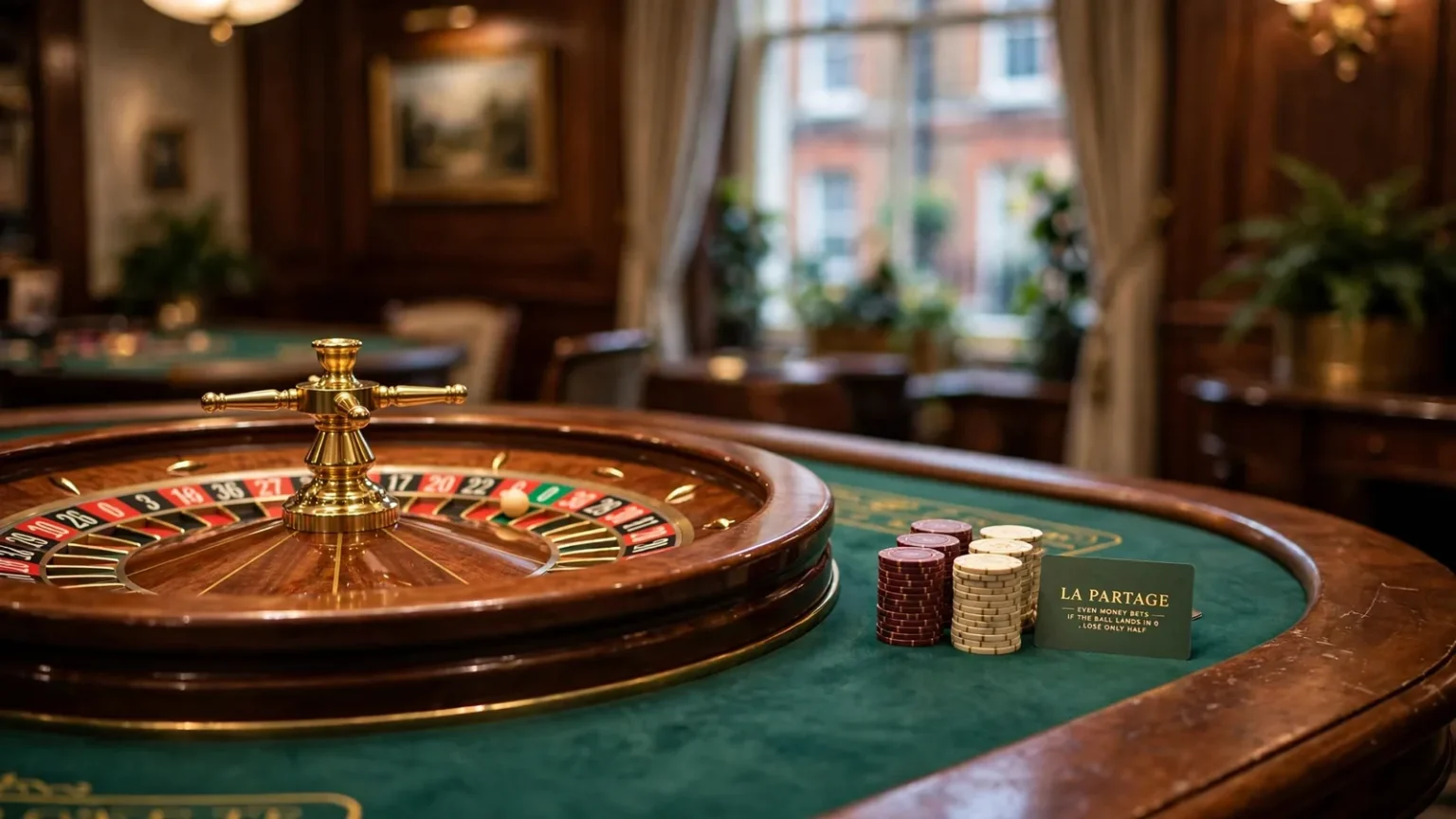
With La Partage, an even-money bet does not disappear completely when the ball lands on zero. Half of the stake is returned to you. The other half is lost.
That refund reduces the house edge on even-money bets to 1.35%. In practical terms, the zero still hurts, but it no longer turns the whole wager into a loss. Over a large number of spins, that difference matters.
I find it easiest to think of La Partage as damage control rather than a bonus. It does not pay you for backing the wrong colour, and it does not turn zero into a winning result. It simply prevents the casino from keeping the entire stake in that particular situation.
That is why the rule is most valuable to people who prefer the broad outside bets. If you are betting red or black, for instance, zero is the awkward result that falls between the two choices. La Partage gives some of the stake back when that awkward result arrives.
A small mercy. Still useful.
En Prison: the bet is not settled immediately
En Prison takes a different approach to the same problem. When zero appears on an eligible even-money bet, the wager is held rather than being settled as a complete loss straight away. The stake remains “in prison” for the next spin.
If the next spin lands on the side you backed, the original stake is released. If the next spin does not rescue the bet, the wager is lost. The exact presentation can vary between tables, so the game information is worth reading before you place a real-money bet.
The key point is that En Prison gives the bet another chance after zero. It does not predict the next result, and it does not make the following spin more likely to favour you. The wheel has no memory. The rule changes how the casino settles the wager, not the chance of the ball landing on any particular pocket.
This is also why I would not describe En Prison as a strategy. You are not finding a pattern or gaining control over the wheel. You are receiving different terms for one narrow outcome.
Why French roulette has the lowest standard edge
French roulette has the lowest house edge among standard roulette variants because of La Partage and En Prison. Both rules reduce the cost of zero for even-money bets, although they do so in different ways.
La Partage gives back half of the stake immediately. En Prison keeps the wager open for a further spin. Either way, the player is treated more favourably than under a version where zero simply takes the entire bet.
French roulette offers mathematical advantages for even-money bets through the La Partage and En Prison rules, which soften the impact of the zero pocket.
That does not mean every wager on a French table receives the same benefit. The clearest advantage applies to even-money bets. A straight-up number bet, for example, is not transformed by La Partage just because it is placed on a table labelled French roulette. The special protection is connected to the eligible outside bets affected by zero.
So when I compare an online casino French roulette table with another roulette option, I look past the name and check the actual rules shown in the game information. “French” is meaningful when La Partage or En Prison is genuinely active. Without those rules, the label alone tells me much less.
A lower edge is not a guarantee
The 1.35% house edge on eligible even-money bets is lower, not negative. The casino still has the mathematical advantage. A session can finish with a loss, and a run of unlucky spins can arrive just as easily on a French table as anywhere else.
That is the part advertising tends to blur. A better deal does not mean a safe deal. La Partage and En Prison reduce the built-in disadvantage; they do not remove variance, repay earlier losses or make the next result knowable.
For me, that is the sensible reason to consider French roulette online in the UK: the rules are more forgiving when zero appears, particularly if I am choosing even-money bets. It is a mathematical improvement, not a promise of profit.
Finding French Roulette at a UK Casino Without Trusting the Badge
A casino can put “French roulette” in a banner, a menu tile or a page title without making the important part clear: is the game actually available, and is the site allowed to take your money in Britain?
Hi-Lo Casino UK: What Search Results Can Confirm
I have made the mistake of treating a familiar badge as proof. It looked official enough, so I moved on to the games. That is backwards. For a UK player, the first check is the operator’s legal position. The second is whether the advertised French roulette table is genuinely in the lobby, rather than being a keyword on a landing page.
The UKGC is the licence that matters
The UK Gambling Commission, usually shortened to UKGC, regulates online casino activity in Great Britain. It is the relevant regulator for an online casino accepting real-money customers in England, Scotland or Wales.
That gives you a straightforward test. If a site says it serves British players, look for its operator name and UKGC licence details. Then check those details against the UKGC public register. Do not rely solely on a logo in the footer, a “licensed” tick, or wording such as “regulated gaming”. Those labels can be presented in a way that feels reassuring while leaving you to guess which company actually holds the licence.
The register check should match the business named in the casino’s terms and conditions, not merely the brand shown at the top of the screen. A gambling website may use a consumer-facing name that differs from the legal operator. That is not automatically a problem, but the relationship should be clear. If the legal name, licence information and site identity do not line up, I would stop before opening a payment page.
A valid UKGC licence is not a decorative trust mark. Remote gambling operators selling into the British market must hold the appropriate Gambling Commission licence, regardless of where the business is based. A foreign or offshore licence does not replace it. A platform without a valid UKGC licence cannot legally offer real-money live roulette to British residents.
Licensing Check
Always verify an operator’s details against the UKGC public register. A foreign or offshore licence does not permit a company to offer real-money gambling to British residents.
That distinction matters when you see a table described as “live French roulette”. A site may be accessible from Britain and still sit outside the UKGC system. Accessibility is not the same as permission to provide the service here. I would not treat a foreign regulator’s seal as a substitute for checking the UKGC register.
Treat the game claim as a separate check
A UKGC licence tells you about the operator’s permission to offer gambling. It does not prove that a particular French roulette table is available to you.
Game menus change. A page may describe several roulette variants, while the logged-in lobby shows only selected games. Some tables may be restricted by location, account status or the format being offered. “French roulette” might refer to a live table, a computer-generated game, or simply a category label. The badge alone tells you very little about that difference.
Before depositing, I would look in the actual casino lobby for the named variant and open its information panel. The useful signs are ordinary and unglamorous: the game title is stated clearly, the table loads for your account, and the rules or paytable identify what you are about to play. If the page keeps sending you back to a registration screen, shows a generic roulette image, or makes the variant impossible to distinguish from European roulette, the claim has not been properly demonstrated.
This is also where “premium” language needs to be kept in its place. It may describe presentation, a studio table or a branded room; it does not establish that the operator is licensed or that the game is available to British customers. Check the legal operator first, then the real lobby, then the game information.
Fast payout online casinos in the UK: assessing claims
Age verification comes before depositing
A UKGC-licensed operator must verify your age before allowing you to deposit funds into a gambling account. So an age check is not an optional nuisance added after you have chosen a table. It is part of the entry process.
You may be asked for information or documents that confirm your identity and age. The exact process can differ between operators, but the practical point is consistent: you should not be able to fund the account first and sort out age verification later. If a website encourages an immediate deposit while postponing basic checks, that is a reason to be cautious.
Being old enough to gamble does not cure a licensing problem either. The two checks answer different questions. Age verification concerns whether you may use the gambling service. The UKGC check concerns whether the operator may provide that service to British players.
Two separate gates.
A quick pre-deposit routine
When I check a casino advertising French roulette, I use this order:
- Find the legal operator name in the footer or terms.
- Locate the stated UKGC licence details.
- Confirm the operator on the UKGC public register before depositing.
- Make sure the site is offering the service to customers in Great Britain under that operator, rather than pointing to an offshore alternative.
- Register only far enough to see whether age verification is required before any deposit.
- Sign in and confirm that the advertised French roulette game is present in the real lobby.
This process will not tell you which casino is “best”, and it is not meant to. It filters out a more basic problem: mistaking a polished badge or an attractive game description for proof that you are dealing with a lawful UK-facing casino. Fancy wording can wait. The register cannot.
What “Best” Means When You’re Comparing French Roulette Casinos
“Best” is a slippery word in casino advertising. I have clicked plenty of tables described as “premium”, “exclusive” or “top-rated”, only to find that the useful information was buried behind several menus. For French roulette, I would ignore the label and compare what you can actually inspect before committing money.
The strongest option is not automatically the one with the biggest welcome offer. It is the one that lets you understand the game, the bonus conditions and your own account settings without making you hunt for them.
Start with the game information
A French roulette table should have an information panel, help button or rules page that explains the game and displays its RTP information. RTP is not a promise about what your individual session will return, but it is still important data. If the figure is difficult to find, shown only in an image, or missing altogether, that tells me something about the casino’s transparency.
House Edge (Even-money)
1.35% with La Partage
Key Rules
La Partage and En Prison
Regulator
UK Gambling Commission (UKGC)
I also check that the information belongs to the specific table rather than to roulette in general. A casino may offer several versions, including RNG and live tables, and their presentation, rules or available bets may differ. The name “French roulette” on a tile is not enough for me. I want the table’s own rules and RTP details available before I play.
That is a more useful test than a badge saying “best French roulette casino”. Badges are decoration. Game information is evidence.
Treat bonuses as paperwork, not free cash
A welcome promotion can look generous while being awkward for roulette players. The key detail is game weighting: how much of your roulette wagering counts towards the bonus requirement. Across UK operators, roulette wagers are commonly assigned a weighting of 10% to 20%, but the exact treatment belongs in the terms for that promotion.
The distinction between live and RNG roulette matters too. Roulette bonus contribution can vary by format: live roulette may receive 10% or 20% game weighting, whereas RNG roulette may receive 100%. Those figures are not interchangeable, and a bonus that works reasonably for an RNG table may be far less practical on a live one.
I would look for four things before accepting bonus funds:
- whether French roulette is eligible at all;
- whether live and RNG roulette receive different game weighting;
- whether the table has a maximum stake condition while bonus funds are active;
- whether excluded games, payment rules or expiry conditions apply.
Some promotions exclude live roulette entirely from no-deposit bonus wagering. Where it is included, a specialist casino review reports a contribution range of 0–10%. I would still treat that as a prompt to read the operator’s current terms, not as a universal rule. Promotional wording changes, and the offer page is the document that controls your account.
There is also a current ceiling worth checking. A specialist industry report states that, from January 2026, licensed operators must keep bonus wagering requirements at no more than 10x. Even with that cap, the smaller print still matters: game weighting determines how quickly roulette play counts, while maximum stakes and excluded games can prevent some wagers from qualifying.
I once looked only at the headline bonus and missed the weighting table. That was backwards. The headline was memorable; the condition was expensive.
Compare clarity, not just the offer
When comparing an online casino for French roulette, I would give credit to the operator that explains its promotion in plain language. Can you see the wagering requirement, eligible games, game weighting and withdrawal conditions on the same terms page? Are important restrictions displayed before you opt in? If the answer is no, the bonus is not necessarily unusable, but it is harder to assess honestly.
Do
- Read the specific game rules and RTP in the information panel
- Check the wagering requirements and game weighting for bonuses
- Verify the legal operator name against the UKGC register
Don’t
- Rely on a “premium” or “best” label as proof of quality
- Assume all roulette variants have the same bonus contribution
- Trust a logo without checking the actual licence details
A clean terms page also makes comparisons fairer. One casino might offer a larger headline bonus with low roulette weighting; another might offer less promotional value but let roulette wagers count more fully. Without the weighting information, comparing the advertised amounts is mostly guesswork.
I would also avoid treating an easy-to-claim bonus as proof that the casino is better. Bonus funds can add restrictions to a session you would otherwise keep simple. If the promotion makes you play a game or stake in a way you did not originally intend, its value to you may be poor even when the advertisement looks attractive.
Account controls are part of the comparison
The account area deserves the same attention as the game lobby. A useful casino should make its financial limit controls easy to find rather than hiding them in support pages. New customers must be prompted to set a financial limit before their first deposit, and account-level controls should remain accessible afterwards.
I look for practical controls covering deposits, losses and session activity, together with self-exclusion access. These are not decorative responsible-gambling statements. They affect how easily you can keep a planned session within its boundaries.
For UK-licensed live casino operators, the available protections must include deposit limits, loss limits, session-time reminders, reality checks, cool-off periods and GamStop self-exclusion. If those options are difficult to locate or the wording is vague, I would not call the account experience strong, regardless of how attractive the roulette page looks.
My shortlist, then, is simple: visible RTP information for the actual table, bonus terms that explain game weighting, and account controls you can use without assistance. That is what “best online French roulette casino” means in practical terms—not the loudest advert, but the clearest arrangement.
Fast Payout Online Casinos in the UK: What to Check
Low Stakes, Standard Tables and the Cost of Chasing Losses
A low minimum stake can make French roulette look gentle on the bankroll. It does not make the session low-risk. The minimum only tells you the smallest wager the table accepts. It says nothing about how many bets you will place, how quickly you will repeat them, or what happens when you try to recover a loss.
I made that mistake myself. I saw a low-limit table and treated the small opening bet as a kind of safety rail. It was not. I stayed longer, added more spins, and gradually turned a modest starting wager into a much larger total exposure. The table had not become dangerous; my decisions around it had.
Read the table limit as a boundary
When you compare French roulette tables, look at both ends of the betting range. A low-stakes table may suit someone who wants to keep each individual wager small. A standard-limit table may allow more room, while a VIP or high-limit table is designed for substantially larger wagers. None of those labels tells you whether the session is affordable.
The important point is that a table limit applies to the bet, not to your overall result. A low-limit French roulette casino can still take a meaningful amount from your bankroll if you keep playing after losses. Likewise, a high-limit French roulette casino does not automatically offer a different kind of roulette outcome. The wheel does not know whether the table is described as standard, premium or VIP.
Attention
A low minimum stake is not a risk rating. It does not prevent a session from becoming expensive if you chase losses or increase your wagers.
Before joining a table, decide what you can afford to lose during that session and treat it as a firm stopping point. Do not use the table’s maximum as a target, and do not assume that a low minimum gives you permission to keep going. “Low stakes” describes the entry point. It is not a risk rating.
Why the Martingale looks convincing
The Martingale is easy to understand: after every loss, you double the next bet, hoping that one eventual win will recover the previous losses and leave a small profit. On paper, the sequence can look tidy. In real play, the required wager grows rapidly when losses arrive one after another.
That creates two separate problems. First, your bankroll can be drained before the hoped-for win appears. A losing streak can negatively affect it long before the table’s maximum is reached. Second, even if you have money available, the casino may impose a maximum stake that prevents the next doubling step. The plan then stops at precisely the point where it was supposed to recover earlier losses.
A low minimum does not solve either problem. In fact, it can make the progression feel harmless at the beginning because the first wager is small. The danger appears later, when the next bet is based on the accumulated losses rather than on what you originally intended to risk.
I have also seen the emotional trap: after several losses, stopping feels like accepting defeat, while doubling feels like taking control. It is not control. It is a decision to put more money behind the same uncertain process.
Keno Online Casinos in the UK: Draws and Payouts
Set the stake before the result
A more grounded way to approach a low-stakes table is to choose a stake that remains acceptable if the result goes against you repeatedly. Keep that amount stable rather than increasing it to chase what has already gone. If losing the next bet would make you uncomfortable, the wager is already too large for the session.
Table limits still matter, but they are only one part of the picture. Check the minimum, maximum and your own total spending boundary. Leave room for the possibility that several results will go against you, because roulette outcomes are determined solely by chance. Previous losses do not make a win due, and a recent run does not give the next spin a direction.
No betting system can predict the final outcome. Doubling, switching colours or waiting for a particular pattern changes how much you risk, not the chance-based nature of the spin.
Small opening bets, firm boundaries. That is the difference.
Live Dealers, Auto Roulette and the Pace of a Spin
The phrase “live French roulette” sounds like one clear product, but the format changes the whole feel of a session. A streamed table gives you a physical wheel, a dealer and a ball drop. RNG roulette replaces that setup with software that uses a random number generator to simulate each spin. Both are chance-based, yet they do not feel remotely the same once you notice the pace.
Live dealer roulette
With a live casino French roulette table, cameras show a real wheel in a studio. A human dealer announces the betting period, spins the wheel and releases the ball, so you can watch the physical result develop rather than see a software animation produce it. There is usually more waiting between spins, but that pause can be useful. I have found it easier to notice how long I had been playing when a dealer, chat window and repeated wheel cycle were visible.
Live Dealer
Features a real wheel and a human dealer in a studio setting, typically offering a slower pace.
RNG Roulette
Software-based simulation using a random number generator, offering much faster gameplay.
Auto Roulette
Uses a physical wheel with automated operation, sitting between live and RNG formats.
Live play is not automatically expensive. UK live roulette tables can have minimum bets starting at 10p. That is a table condition, not a promise that a whole session will stay low-risk. Your total spend still depends on how often you bet and how quickly you return to the table.
A UK-licensed live casino must also provide practical gambling controls. These include deposit limits, loss limits, session-time reminders or reality checks, cool-off periods and GamStop self-exclusion. The controls should be available at account level, not hidden behind the game screen. I now check those settings before opening a table. Much less clever to remember afterwards.
RNG roulette
RNG roulette is the stripped-back version. There is no streamed studio and no physical ball; the software generates the simulated result. That makes it faster and often lets casinos offer smaller entry points, with minimum stakes sometimes as low as 10p.
The speed difference can be substantial. RNG American roulette commonly reaches 150 to 200 or more spins per hour, whereas live dealer play is commonly listed at 50 to 60 spins per hour. Those figures describe the format, not a better chance of winning. More results in the same period simply mean more opportunities to place bets.
Auto roulette sits between the two experiences. It uses a physical wheel and automated operation rather than a human dealer handling every stage. You may still watch a real ball land, but the table can move with less conversation and fewer pauses. That can suit someone who wants the live-wheel element without the full studio presentation.
Speed and auto formats
Speed roulette is designed to compress the waiting time. A specialist review reports rates above 150 spins per hour, compared with 80–100 at a standard table. Treat that as a format description rather than a fixed promise: the actual rhythm depends on the operator, table and betting window.
Live Casino Lightning Roulette in the UK: How It Works
A specialist review also reports that auto-roulette and speed tables can begin at 5p, while live tables can begin at 10p. Minimums change by table, so read the displayed rules before joining. A small minimum does not make rapid play harmless; it can simply make repeated bets easier to place.
For a live French roulette casino, choose based on what you want to observe: a real wheel and dealer, a faster automated table, or the quickest software simulation. The format changes the atmosphere and number of spins, not the underlying uncertainty of each result.
The Wheel, the Bets and the Payouts
A French roulette casino game uses a numbered wheel with pockets from 1 to 36 and a single zero. On an online table, you place chips on the betting layout before the betting period closes. The position of your chip determines the type of wager, and the winning pocket determines whether that wager pays.
The simplest inside bet is a straight-up bet on one number. If the ball lands on that number, the payout is 35:1. This applies to both European and American roulette. The single-number wager is easy to understand, but it covers only one pocket.
A split bet covers two adjacent numbers by placing the chip on the line between them. Its payout is 17:1. A street bet covers a horizontal row of three numbers and pays 11:1. These are still inside bets because they use specific positions on the numbered section of the layout rather than a broad colour or range.
Outside bets cover groups of outcomes. You can choose red or black, even or odd, or high or low. Each of these pays 1:1 when the result qualifies. The zero sits outside those categories, so it does not count as red or black, even or odd, or high or low.
Inside Bets
Bets placed on specific numbers or small groups of numbers within the numbered section of the layout, such as straight-up or split bets.
That is the basic map: inside bets select a small, defined group of numbers, while outside bets cover wider categories. The wider coverage does not make a result more predictable; it simply changes which outcomes your wager includes and how the payout is set.
When reading an online French roulette table, check the chip position carefully before confirming the bet. A chip placed directly on a number is different from one positioned on a dividing line or in an outside-bet box. The game interface should show the selected wager and its potential payout before the spin.
The payout format can look cryptic at first. “35:1” means the listed return is tied to the amount placed on that winning bet; “1:1” describes an even-money payout. Focus first on what the chip covers, then read the displayed odds. That small pause has saved me from more than one badly placed chip.
Checking That an Online Casino Really Has French Roulette
A casino may use “roulette” as a broad label while offering several different tables underneath it. If you want French roulette, open the casino lobby and look for the full game name before depositing. Do not rely on a banner, search tile or promotional wording alone.
Open the individual game page as well. It should identify the variant clearly rather than leaving you to guess from the table design. Check whether the rules mention La Partage and En Prison: these are the features that give French roulette the lowest house edge among standard roulette variants. If neither rule appears in the information panel, you may be looking at European roulette with French-style artwork instead.
Live Baccarat Online Casinos in the UK
The same game-information panel should make the RTP accessible. Read it before you play, and check that it applies to the exact table or version selected. An RTP figure attached to a general roulette category is not enough when several variants sit in the same lobby.
I have made the mistake of opening the first roulette table that appeared, assuming the name covered everything. It did not. A thirty-second check of the rules would have been cheaper than discovering the difference through a session.
Before making a deposit, also verify the operator’s licence number on the UK Gambling Commission public register. A platform without a valid UKGC licence cannot legally offer real-money live roulette to British residents. Age verification must take place before an operator allows you to deposit funds. These checks are separate from confirming that the advertised game is genuinely French roulette, but both belong on the same pre-deposit checklist.
Availability first. Labels second.
What “Premium” French Roulette Can—and Can’t—Tell You
“Premium” sounds reassuring, but it is a label, not a mathematical upgrade. I have learned to treat it as packaging: it may describe the table’s presentation, interface or service around the game, but it does not prove better odds or a more favourable version of French roulette.
The useful question is simpler: what is actually happening on the table?
A live French roulette table streams a real wheel from a studio. You see a human dealer place the ball and release it onto the physical wheel, rather than watching a result produced by a random number generator behind the screen. That can make the session feel closer to a casino visit, with the wheel, dealer and ball drop visible as they happen.
Meaningful Details
Look past the decorative labels and verify the specific rules, RTP, and licensing for the actual table you intend to play.
That experience is different from a premium-looking automated table. A polished design, branded room or dramatic camera angle does not by itself mean there is a real wheel in use. If the distinction matters to you, open the game information and look for clear wording about a live dealer, studio stream and physical wheel. If those details are absent, the badge has not told you much.
I also would not assume that “premium” changes the underlying French roulette rules. The table name still needs checking, as does the information provided for that specific game. Labels are easy to add; useful detail takes more effort.
My old mistake was paying attention to the room before the table. The background looked expensive, so I assumed the game deserved more trust. It was only decoration. Look past the velvet language and identify whether you are watching a real wheel operated by a dealer. That is the meaningful distinction here.
Before You Play: One Number, One Spin, No Prediction
The easiest mistake to make at an online roulette table is treating the next spin as if it owes you something. I have done it myself: a number appears, I decide it is “due”, then place a bet as though the wheel has been keeping score. It has not.
Each spin is its own uncertain event. The final result is determined by chance, whether you are playing French roulette online through an automated game or watching a dealer release the ball on a physical wheel. Previous results may look like a pattern, but they do not tell you what will happen next.
That is why betting systems cannot predict the winning number. A staking plan can change how you arrange or increase your bets, but it cannot change the odds governing the spin. No system can turn a guess into information. No prediction model can see around chance.
I find it useful to decide what a spin means before placing anything: one small wager, one result, then a pause. If it loses, that is not evidence that the next spin must win. If it wins, it is not proof that a run has started. Both conclusions are stories added after the event.
Live Blackjack Online Casinos in the UK: What to Check
The same applies when a number has appeared repeatedly. Chasing it because it feels “hot”, or avoiding it because it feels “finished”, gives the impression of control without creating any. The wheel does not remember your last bet.
So approach each spin as a fresh gamble, not a test of skill or a puzzle waiting to be solved. Settle for uncertainty. That is the honest version.
French Roulette Compared with American Roulette
When comparing casino French roulette with the American version, start with the wheel rather than the table graphics. French roulette uses the single-zero layout: numbers 1 to 36 plus one green zero, giving the wheel 37 pockets. American roulette adds another green pocket, marked double zero, making 38 in total.
That extra pocket is not decorative. Every spin gives the house one more outcome that is outside the usual red, black, odd, even, high or low groupings. It slightly reduces the chance of those outside bets winning, while the payout shown on the layout does not rise to compensate. The same issue affects number bets: the wheel has more possible landing places, but the standard payout structure remains familiar.
The difference shows up clearly in the mathematical house edge. European roulette is listed at 2.70%, while American roulette carries a 5.26% edge. In plain terms, the American wheel takes a larger statistical slice over a long run of bets. That does not mean a particular spin is more predictable; it is a difference in the underlying design.
American roulette also has a basket bet covering zero, double zero, and the first three numbers. Its house edge is 7.89%, making it a particularly costly option. Some American tables in UK online casinos have even included a third green pocket marked 000. A specialist affiliate review has reported a 7.69% house edge for that format, but that is a specific reported variation, not a market-wide standard.
So, if you are choosing between variants, count the green pockets first. One zero is already enough to give the casino its built-in advantage. Two make that advantage materially heavier.