

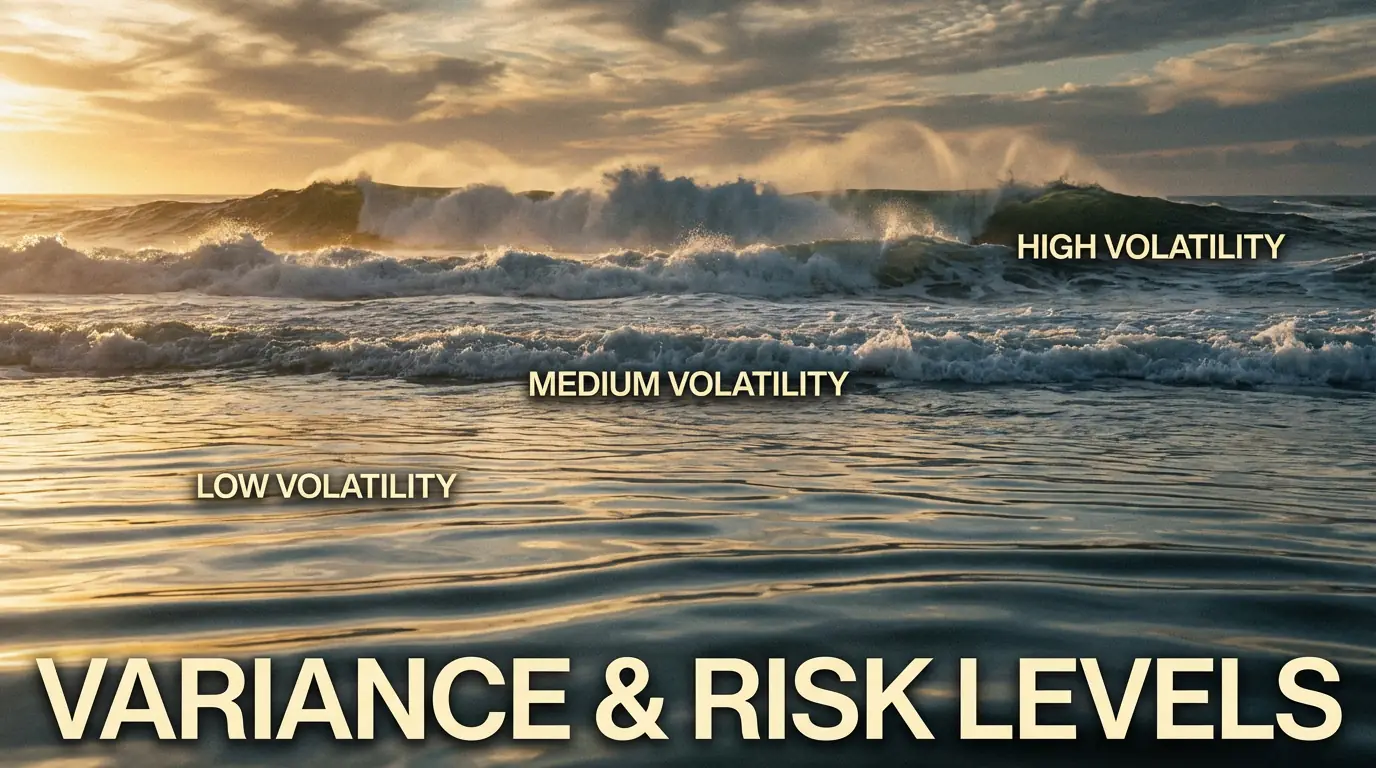
The Hidden Metric That Shapes Your Sessions
Two slots with identical 96% RTP can deliver completely different experiences. One pays small wins frequently, keeping your balance stable across hundreds of spins. The other goes quiet for extended stretches before delivering substantial payouts that can transform your session. The difference lies in volatility, a metric that describes how returns distribute rather than how much returns overall.
Understanding volatility helps match game selection to your preferences and bankroll. Players seeking extended entertainment sessions need different games than those chasing life-changing wins. Neither approach is superior, but mismatches between expectations and game characteristics create disappointment regardless of mathematical outcomes. This guide explains volatility levels and how to use them for better game selection.
What Volatility Actually Measures
Volatility describes the distribution pattern of slot payouts over time. Mathematically, it measures the standard deviation of returns from the theoretical average. High standard deviation means results scatter widely around the expected return, with many losing spins punctuated by large wins. Low standard deviation means results cluster closer to expected values, with frequent small wins smoothing session variance.
RTP and volatility operate independently. A 96% RTP slot returns £96 per £100 wagered on average regardless of volatility level. However, a low-volatility 96% slot might achieve this through hundreds of small wins, while a high-volatility 96% slot achieves the same average through rare but substantial payouts. Both reach identical long-term returns through different paths.
Session experience depends heavily on volatility. Low-volatility slots feel steady, with balances fluctuating modestly and dry spells remaining short. High-volatility slots feel dramatic, with extended losing streaks creating tension before potential big wins provide relief or triumph. The emotional experience of playing differs fundamentally between volatility levels even when mathematical expectations match.
Bankroll requirements increase with volatility. Surviving the losing stretches inherent to high-volatility play requires larger reserves. A bankroll sufficient for hours of low-volatility play might disappear within minutes on a high-volatility slot experiencing a cold streak. Matching volatility to available funds prevents premature bust-outs that deny you opportunity for the big wins high-volatility games can deliver.
Low Volatility Slots
Low-volatility slots prioritise frequent wins over large payouts. Expect wins on a significant percentage of spins, though individual win amounts tend to be modest relative to stake size. Your balance rises and falls gradually rather than swinging dramatically. Sessions feel consistent and predictable within normal variance bounds.
Entertainment-focused players often prefer low volatility. If your goal involves extended play sessions maximising time at the screen, low-volatility games deliver more action per pound wagered. The steady stream of wins maintains engagement without requiring large bankrolls to survive dry spells. Casual players and those gambling for relaxation frequently find low-volatility slots most enjoyable.
Bonus clearance benefits from low volatility in many cases. The consistent returns help meet wagering requirements with more predictable results. High-volatility variance can either clear requirements quickly through lucky big wins or deplete bonus funds entirely during cold streaks. Low volatility reduces both upside and downside, trading potential for consistency.
Win potential caps effectively at lower levels. The same mechanics producing frequent small wins prevent the massive payouts high-volatility games can deliver. If your gambling motivation centres on life-changing win potential, low-volatility slots cannot satisfy that goal regardless of session length or total wagering.
High Volatility Slots
High-volatility slots concentrate returns into infrequent but substantial payouts. Many spins return nothing or minimal amounts, creating extended losing periods. When wins arrive, they often multiply stakes significantly, sometimes hundreds or thousands of times the bet amount. The experience alternates between grinding disappointment and explosive excitement.
Jackpot hunters and thrill-seekers gravitate toward high volatility. If gambling represents a chance at transformational wins rather than steady entertainment, high-volatility games provide appropriate risk-reward profiles. The possibility of massive returns justifies accepting likely losses during most sessions. Players viewing gambling as lottery-adjacent appreciate this structure.
Bankroll management becomes critical at high volatility. The extended losing stretches require sufficient funds to reach the big wins that justify the variance. Underfunded high-volatility play frequently ends in total bankroll loss before variance delivers its potential upside. Serious high-volatility players size bets conservatively relative to available funds, accepting more spins at lower stakes over fewer spins at higher stakes.
Session outcomes vary dramatically. A single session might deliver thousand-times stake wins or consume your entire bankroll without a single significant hit. This unpredictability defines high-volatility appeal for some players while making it unsuitable for others. Honest self-assessment about your tolerance for losing sessions determines whether high volatility matches your temperament.
Medium Volatility: The Middle Ground
Medium-volatility slots balance frequency and size of wins. You experience enough regular hits to maintain engagement while occasional larger wins add excitement beyond base game monotony. Most modern video slots fall into medium volatility categories, reflecting designer attempts to appeal broadly.
The compromise suits players uncertain about extreme preferences. If neither steady small wins nor rare large wins sounds obviously superior, medium volatility provides sampling of both experiences. Many players discover their actual preferences through medium-volatility play before gravitating toward extremes that better match discovered inclinations.
Bankroll requirements fall between extremes. Medium volatility tolerates smaller reserves than high-volatility play but benefits from more cushion than low-volatility minimum stakes provide. The moderate variance creates reasonable session lengths without demanding the substantial bankrolls high-volatility sustainability requires.
Game selection becomes easier with medium volatility since most slots occupy this space. Finding low or high volatility specifically requires intentional searching, while medium volatility appears by default across typical casino game libraries.
Choosing the Right Volatility for You
Bankroll size should influence volatility selection significantly. Limited funds pair better with low volatility, maximising play time and minimising bust risk. Substantial bankrolls enable high-volatility play where the potential upside justifies accepting extended losing periods. Mismatching bankroll size to volatility level leads either to unnecessarily conservative play or premature bust-outs.
Session goals matter for volatility matching. Entertainment-focused sessions aiming for relaxation and extended screen time suit low volatility. Adrenaline-seeking sessions chasing big win excitement suit high volatility. Bonus clearance often favours low to medium volatility for consistent wagering progress. Identifying what you actually want from a session guides appropriate volatility selection.
Emotional tolerance for losing streaks varies individually. Some players handle extended dry spells patiently, viewing them as necessary precursors to big wins. Others find losing streaks frustrating regardless of intellectual understanding that variance works this way. Honest self-assessment about your emotional responses helps identify sustainable volatility levels.
Finding volatility information requires checking game details. Some providers clearly label volatility in game information screens. Others require consulting external databases or provider websites. Games without clear volatility disclosure can be assessed roughly through paytable analysis, where concentrated payouts on rare symbol combinations indicate higher volatility than distributed payouts across many symbol sets.
Experimentation in free play mode reveals volatility characteristics directly. Demo versions demonstrate win frequency and typical win sizes without risking real money. Playing several hundred demo spins provides practical volatility sense beyond abstract categorisations.
Volatility Questions Answered
Players commonly ask whether volatility affects RTP. It does not. Volatility describes distribution patterns while RTP describes total returns. A 96% RTP slot returns 96% on average regardless of whether it achieves this through frequent small wins or rare large ones. The metrics measure different aspects of game behaviour.
Questions arise about whether casinos can adjust volatility. Unlike RTP, which some games allow operators to configure, volatility is typically fixed by game design. The mathematical structure determining win distribution is embedded in game mechanics rather than adjustable parameters. The volatility you experience should match what the game inherently provides.
Some players wonder whether volatility changes during sessions. It does not. Each spin operates independently with identical probability distributions. Perceived patterns like hot streaks or cold spells reflect variance rather than changing volatility. The game’s mathematical characteristics remain constant regardless of recent results.
Questions about optimal volatility for winning arise frequently. No volatility level increases or decreases your expected returns since RTP determines that independently. Volatility affects experience and variance, not long-term mathematical expectations. Choosing volatility based on preferences rather than winning probability makes more sense given this mathematical reality.
Find more slot guides at trustedcasino-uk. Also read our slots RTP guide.